
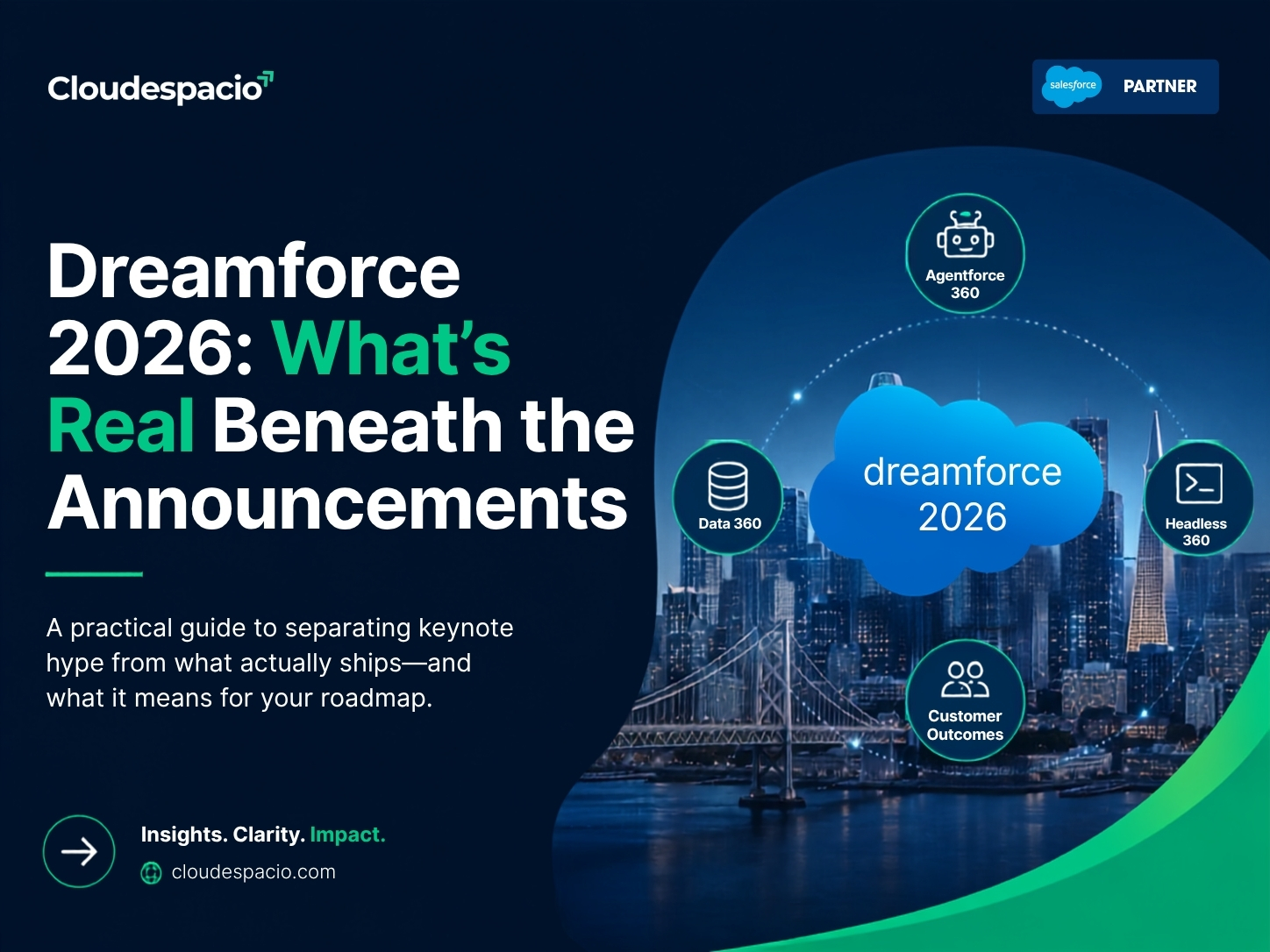
Dreamforce returns to Moscone Center in San Francisco from September 15 to 17, 2026, and by the time you read this, the marketing machine will already be in full swing. The official theme, “Becoming an Agentic Enterprise,” tells you exactly where Salesforce wants the conversation to go this year. But if you’ve sat through a few of these events, you know the keynote stage and the actual implementation timeline rarely move at the same speed.
At CloudEspacio, we work with teams who have to make real budget and roadmap decisions based on what Salesforce says at events like this. So before you build next year’s plan around a 90 minute keynote, it’s worth slowing down and separating what’s genuinely shipping from what’s still aspirational. This guide walks through both sides: what to expect on stage, and what history tells us actually shows up in your org months later.
To understand what Dreamforce 2026 is trying to prove, it helps to remember what the last two years set up.
Dreamforce 2024 introduced Agentforce as a bold, early idea: AI agents that could take real action inside Salesforce rather than simply making suggestions. It was more concept than product for a lot of attendees, and plenty of skepticism followed it out of Moscone Center.
Dreamforce 2025 pushed that story much further. Agentforce 360 launched as the unifying layer for the platform, tying together agent building tools, governance frameworks, and observability. Data Cloud was rebranded and expanded into Data 360, giving agents contextual awareness over both structured and unstructured data. Salesforce also announced a deep partnership with OpenAI, putting GPT-5 inside the platform and surfacing Agentforce data within ChatGPT itself. Then TDX 2026 in April added Headless 360, a set of more than 60 MCP based tools that let agents operate without a browser at all, driven entirely by CLI and API access.
That’s the run-up. Dreamforce 2026 is where all of it is supposed to prove out at scale, not as a pitch deck concept, but as something organizations are actually running production workloads on.
Salesforce has confirmed some of the scope for this year’s event, and it’s worth knowing what you’re walking into if you’re attending in person or planning your Salesforce+ viewing schedule:
That volume of content is both the opportunity and the trap. There is genuinely useful, specific information buried in this event. There is also a lot of repetition and marketing gloss. Knowing where to spend your attention matters more than trying to absorb all of it.
The core keynote framing this year centers on Marc Benioff and guests exploring what it actually means to become an Agentic Enterprise, where humans, agents, and platforms work together toward customer outcomes. Expect the stage to lean heavily on customer proof points: deployment counts, cost savings, resolved case percentages, and specific dollar figures tied to productivity gains.
Those numbers are worth listening to, but they deserve a second look before you repeat them in your own planning documents. A “deployment” can mean a fully autonomous agent handling a complex, multi-step workflow with minimal human oversight. It can also mean a scripted chatbot with updated branding and a new label. The gap between those two things is enormous, and Salesforce’s own materials rarely draw a clean line between them. When you hear a number like “12,000 customer deployments,” treat it as a starting point for questions, not a finished fact.
A few threads are worth tracking closely because they represent real platform shifts rather than repackaged messaging from last year.
First previewed at TDX 2026, Headless 360 extends Agentforce beyond the standard user interface with a large library of MCP based tools that let agents operate through CLI and API access alone. This matters most for teams trying to embed Salesforce logic into other internal systems, mobile experiences, or third party tools without forcing every interaction through the standard Salesforce UI. The developer keynote and sessions this year are expected to go deep on Apex limits, MCP tooling, and how to plan, build, test, deploy, and observe agents using whichever coding tools your team already prefers.
Data 360, the expanded successor to Data Cloud, is positioned as the layer that gives agents trustworthy context from both structured and unstructured sources. Developer sessions are expected to preview Catalog APIs and expanded Python code extension capabilities, which suggests Salesforce is trying to make this layer more accessible to technical teams building custom integrations, not just admins working inside point-and-click tools.
This is worth paying attention to regardless of your AI ambitions, because Data 360 quality is the actual bottleneck behind almost every agent failure story we’ve seen in client environments. Duplicate records, incomplete fields, and inconsistent formats will break an agent’s judgment long before any model limitation does.
Trust Across Agents, Data, and Platforms gets its own keynote slot this year, focused on securing and governing the Agentic Enterprise against evolving threats while still trying to accelerate AI initiatives. The fact that security earned a standalone keynote, separate from the main Agentic Enterprise session, signals that governance is no longer a side conversation reserved for compliance teams. Given how much scrutiny AI agents are under from IT, legal, and security stakeholders, this track is worth prioritizing over some of the flashier product demos happening at the same time.
The relationship with OpenAI continues to expand, with GPT-5 availability inside the platform and Agentforce data surfacing directly within ChatGPT. This continues to blur the line between Salesforce as a CRM and Salesforce as a broader AI infrastructure layer, which has real implications for how you think about vendor lock-in and where your organization’s AI strategy actually lives.
Expect dedicated content tracks for healthcare (patient care, clinical workflows, compliance), financial services (risk assessment, fraud detection, customer intelligence), manufacturing (supply chain optimization, predictive maintenance, quality assurance), retail (inventory optimization, personalized experience, supply chain resilience), and public sector (citizen services, internal efficiency, compliance). If your organization sits in one of these verticals, these sessions tend to be more useful than the general keynotes, because they’re forced to address the specific regulatory and operational constraints your team actually deals with.
Every Dreamforce produces a wave of “coming soon” announcements that quietly slip, get scoped down, or arrive only for specific clouds first. A few patterns worth watching for this year, based on how the last several cycles have actually played out:
Integration dependencies get glossed over on stage. Several of the more impressive Agentforce demos rely on MuleSoft under the hood for complex, integration-heavy workflows. If your organization doesn’t already have MuleSoft in place, or the team to manage it, adopting those workflows is a much bigger and more expensive project than the stage demo implies. Don’t let a slick demo drive a MuleSoft purchase decision on its own.
Partner and marketplace tooling tends to lag the core platform. Streamlined billing, provisioning, and marketplace features for partners building on Agentforce have historically taken longer to reach general availability than the headline AI capabilities do. If you’re a partner or ISV building on the platform, budget extra time here.
Full general availability claims deserve scrutiny. Some products announced with fanfare, like the complete agentic analytics experience promised for Tableau Next, roll out in phases over many months rather than arriving all at once at the keynote. Some features are available at launch; the complete experience often isn’t.
“Available now” and “in preview” get blurred in the room. Features announced at Dreamforce often exist first as limited pilot programs within specific clouds or industries. The actual general release timeline is usually buried several pages into release notes published weeks or months later, not stated clearly from the keynote stage.
Governance claims need a customer story, not a slide. Zero data retention, audit trails, and guardrails sound reassuring in a security keynote. The real test is whether a customer can describe how those controls held up during an actual incident, audit, or edge case, not just how they were designed on a whiteboard.
If you or your team is attending in person, or watching on Salesforce+, a few practical moves will save you months of second guessing later.
Prioritize customer led sessions over product led ones. The Q&A after a real deployment story is where implementation time, data cleanup effort, and change management pain points actually surface. Product marketing sessions are optimized to sound finished. Customer sessions are where the awkward but important details show up.
Ask what “deployed” actually means in every case study you hear. Push for specifics: how many workflows are covered, how much human review is still required at each step, and what happens operationally when the agent gets something wrong.
Treat the developer and admin tracks as ground truth. Product marketing sessions describe the vision. Developer sessions on Apex limits, MCP tooling, and Data 360 APIs describe the actual technical constraints you’ll be working within once you get home. The Salesforce Admin track, running through the Trailblazer Bootcamp days, covers governance, data quality management, and security responsibilities that rarely make it into the main keynote.
Divide the agenda across your team by topic if more than one person is attending. With 1,600-plus sessions on offer, no single person can meaningfully cover Agentforce, Service Cloud, Data 360, governance, integration, and industry-specific tracks alone. Agree in advance what each person needs to bring back and report on.
Run your own data audit before you build anything. Regardless of which announcements pan out, every agent implementation depends on clean, well governed data: no duplicates, complete records, consistent formats. That work doesn’t wait for Salesforce’s roadmap, and starting it after Dreamforce just delays your actual deployment timeline by months.
Is Dreamforce still worth attending in person if budget is tight? Salesforce+ now offers genuinely substantial virtual access, including 400-plus sessions live and on demand. You’ll miss the hallway conversations and informal networking, but for a team focused on technical and strategic content rather than relationship building, the virtual option covers most of the real value at a fraction of the cost.
Will the admin track actually matter for AI governance, or is it just the usual point-and-click content? Admins play a genuinely critical role in AI implementation this year, and Salesforce has said as much. Expect real emphasis on agent governance, data quality management, and security configuration in the admin-specific sessions, not just interface walkthroughs.
How much of this is relevant if we’re not planning to build custom agents right away? Even organizations with no near-term plans to deploy autonomous agents will benefit from the Data 360 and governance content, because clean data and clear access controls matter regardless of whether AI is in the picture yet.
Dreamforce 2026 will almost certainly deliver a compelling case for the Agentic Enterprise. Some of it, particularly around governance tooling, headless access, and data unification, represents genuine platform maturity built over the last two events. Some of it will still be a slide with a “coming Q1 2027” asterisk quietly attached.
The teams that get the most value out of this event aren’t the ones who go home and try to implement everything they saw on stage. They’re the ones who come back with a short, honest list: what’s actually ready to use today, what depends on infrastructure they don’t have yet, and what’s still marketing dressed up as a roadmap.
If you want help sorting through what Salesforce announces this September and mapping it against your own environment, data readiness, and existing tech stack, that’s exactly the kind of work CloudEspacio does. Reach out before the confetti settles.

Cloudespacio is a trusted Salesforce implementation partner headquartered in India, helping businesses transform sales, service, manufacturing, automotive, and customer operations with Salesforce.
Copyright © 2026 Cloudespacio Software Pvt. Ltd. All Rights Reserved.
