
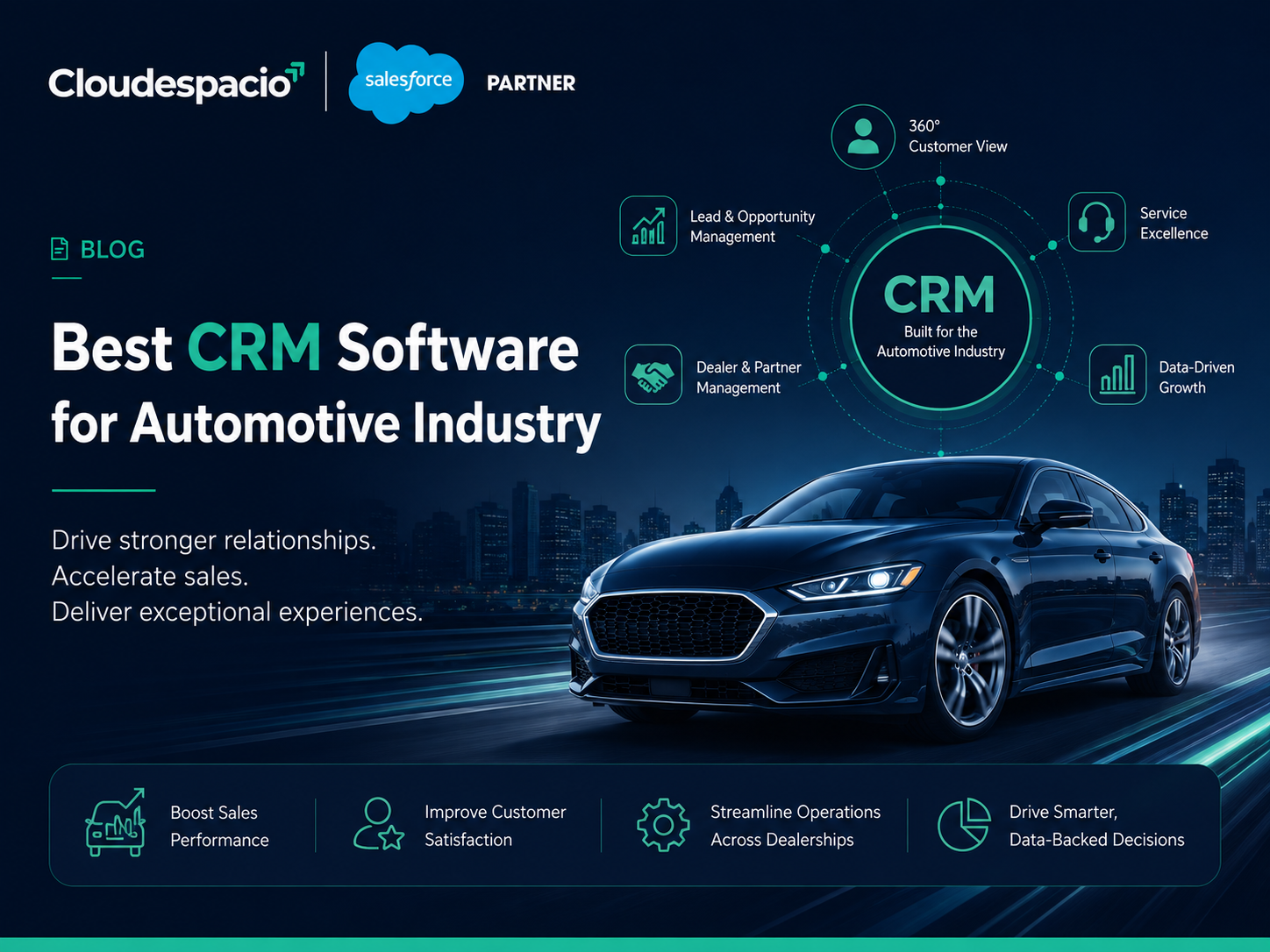
Quick answer: The best CRM software for automotive industry operations in 2026 is Agentforce Automotive, formerly known as Salesforce Automotive Cloud. Unlike legacy automotive CRM software built around leads and deals, this AI CRM for dealerships and manufacturers models the driver, vehicle, dealer, and finance contract as connected records, then deploys autonomous AI agents across sales, service, and captive finance.
Most guides to the best CRM software for automotive industry buyers list ten products and leave you to sort it out. This one takes a position and explains the reasoning.
The sector does not have a lead management problem. It has a data model problem. A single customer might lease one vehicle, own another, service both at different locations, carry a captive finance contract, and generate telemetry from a connected car every day. Legacy automotive CRM software was designed to track a person and an opportunity. It was never designed to track a person, three vehicles, two contracts, a service history, and a dealer relationship as one continuous story.
That gap is why so many dealer groups and manufacturers run four to seven disconnected systems, and why the handoffs between them leak revenue. Agentforce Automotive was built to close it. Here is what the platform does, what it costs, who it suits, and where it is the wrong choice.
The best CRM software for automotive industry use is a platform that models vehicles, drivers, dealers, and contracts natively rather than forcing automotive workflows into a generic sales tool. By that standard, Agentforce Automotive leads the category for OEMs, dealer groups, captive finance arms, and fleet operators, while lighter dealership CRM tools remain the better fit for single rooftop retailers.
Three tiers exist in the automotive CRM software market:
If your organization spans more than a showroom, only the third tier answers the question properly.
Agentforce Automotive is Salesforce’s industry specific AI CRM for the automotive sector. It is built on Sales Cloud and Service Cloud, extended with an automotive data model that natively understands vehicles, ownership, dealer hierarchies, service events, and financing, then layered with Agentforce, Salesforce’s platform for autonomous AI agents.
The naming history matters, because it splits search demand:
Search for either name and you land on the same product line. Partner content, AppExchange, and older documentation still use Salesforce Automotive Cloud interchangeably with Agentforce Automotive.
Most CRM platforms are organized around people and deals. The best CRM software for automotive industry operations has to be organized around people, vehicles, and the relationships between them.
That sounds academic until you try to answer a question like: which customers in this region are within six months of lease end, have an open recall, and last serviced with a dealer holding matching inventory? In generic automotive CRM software that is a data project. In Agentforce Automotive it is a query, because ownership, vehicle definition, service history, dealer hierarchy, and finance contract already exist as related objects.
Older dealership systems did their job well when the customer walked in cold. That world is gone, and it is the main reason buyers are re evaluating the best CRM software for automotive industry needs right now.
The journey moved online. Cox Automotive research shows the average buyer now visits fewer than two dealerships before deciding, and more than 80% start with online research. By the time a lead arrives, the shopper already knows the trim, the price, and the competing offer.
Vehicles became data sources. Roughly 327 million connected vehicles are projected on the road by 2027. Every one generates telemetry that could drive proactive service, warranty action, or a subscription upsell. Automotive CRM software with no vehicle object cannot use any of it.
Revenue moved past the first sale. Margins on new units stay tight. The money increasingly sits in service retention, captive finance, warranty, parts, and connected services, exactly where sales first CRM for car dealerships performs worst.
AI raised the bar on response. Widely cited industry research shows responding within five minutes makes conversion roughly 21 times more likely than waiting 30 minutes. Human teams cannot hold that standard at 11pm on a Sunday. An AI CRM for dealerships can.
The honest framing: DealerSocket, VinSolutions, and Elead are good products for running a rooftop. They were never designed to run a manufacturer, a captive finance arm, and a 90 store retail network on one data foundation. That is the problem Agentforce Automotive solves, and it is why enterprise buyers are redefining what qualifies at network scale.
The foundation is a prebuilt structure matching how the industry actually operates:
None of this has to be custom built, which is the whole argument for buying an industry cloud instead of configuring horizontal automotive CRM software from scratch.
Agentforce Sales Concierges and lead handling agents manage the path from first click to test drive. Agents assist with trade in appraisals, inventory lookup, and dealer search so leads do not sit unworked while a rep is on the floor. Reps search inventory across locations in natural language rather than filtering a grid, which is a capability almost no traditional CRM for car dealerships offers.
Vehicle Service Management plus service agents identify issues, schedule appointments, and send email summaries with estimates before the customer calls. Remote Action Automation and Dynamic Vehicle Assessments support faster, more accurate diagnosis and repair estimates, shortening the cycle from symptom to booked revenue.
Vehicle finance management and collections assistance cover loan processing, payments, and application review. For captives, this separates automotive CRM software that tracks the sale from a platform that manages the twenty four to sixty month relationship after it.
Dealers submit retail delivery reports and proof of sale for parts and accessories. OEMs use that data for rebate calculation and dealer performance analytics. Agentforce Automotive also automates warranty and rebate payouts and coordinates inventory across locations, all classic manual and dispute prone processes.
Purpose built dashboards cover dealer performance, sales lifecycle, revenue trends, regional performance, inventory, and OEM sales projections, instead of forcing you to build reporting from raw objects.
This is the part worth understanding properly, because every vendor now claims AI.
A chatbot follows rules. It answers predefined questions from a script and escalates anything it does not recognize.
An AI agent reasons. It grounds answers in your real data, decides what should happen next, and acts inside the flow of business without waiting for a human to start each step.
Agentforce for Automotive ships prebuilt agent templates trained on automotive jobs to be done, with structured and unstructured industry data harmonized for context. Agents are customized with low code tools, and every interaction runs through the Einstein Trust Layer for privacy, auditability, and compliance. This agentic AI automotive capability is the clearest technical gap between Agentforce Automotive and every legacy competitor.
| Function | What the agent does autonomously |
|---|---|
| Lead response | Engages inbound leads instantly, qualifies intent, books test drives after hours |
| Inventory | Answers natural language vehicle and parts searches across locations |
| Service | Flags issues, schedules appointments, sends estimate summaries proactively |
| Warranty and rebates | Validates claims and automates dealer payouts |
| Finance | Reviews applications, handles payment queries, assists collections outreach |
| Dealer support | Answers dealer questions on programs, allocation, and reporting instantly |
| Fleet | Monitors telemetry, triggers maintenance, flags safety events |
The strategic point: agentic behavior requires unified data. An agent that only sees the CRM cannot make good decisions. Competitors bolting agents onto passive, siloed automotive CRM software struggle to deliver real autonomy, which is why the data model discussion above is not a technicality.
| Segment | Fit | Why |
|---|---|---|
| OEMs and manufacturers | Excellent | Dealer hierarchy, rebate and warranty automation, retail delivery reporting, telemetry |
| Large dealer groups (10+ rooftops) | Excellent | One customer record across sales, service, and finance at network scale |
| Captive finance arms | Excellent | Native contract, application, payment, and collections handling |
| Fleet and mobility operators | Strong | Telemetry driven maintenance and utilization. Ford uses the platform for fleet management |
| Software defined vehicle teams | Strong | Connected vehicle data and subscription models |
| Aftermarket and parts distributors | Moderate | Works well, though less of the automotive model gets used |
Ford uses Salesforce automotive capabilities to support fleet management and reduce operational cost.
DealerCloud, announced by Cars Commerce and Del Grande Dealer Group in February 2026 at NADA, is one of the first dealership CRMs built directly on Agentforce Automotive, designed to unify OEMs, retailers, and buyers on one agentic platform. Initial testing reportedly reduced manual sales steps and produced 38% more sales from new hires, a meaningful signal given how much dealership performance is lost to onboarding and turnover.
The wider signal is that Salesforce Automotive Cloud has become a platform other automotive software is built on, not just an application you buy. For a group weighing a ten year technology decision, that matters more than any feature comparison.
| Phase | Duration | Focus |
|---|---|---|
| 1. Discovery and data audit | 2 to 4 weeks | Map current systems and DMS connections. Find duplicates before migrating them |
| 2. Data model foundation | 4 to 8 weeks | Configure vehicle, ownership, dealer, and finance objects. Connect Data Cloud if used |
| 3. Core CRM go live | 4 to 8 weeks | Sales and service processes for a pilot region or rooftop set |
| 4. First agents | 2 to 4 weeks | Start with one high volume, low risk case such as after hours lead response |
| 5. Scale | Ongoing | Add finance, warranty, marketing, analytics. Expand agent scope as trust builds |
Three failure modes to plan around:
Credibility requires saying this plainly. Do not buy it if:
| Agentforce Automotive | VinSolutions, DealerSocket, Elead | |
|---|---|---|
| Core unit | Driver, vehicle, dealer, contract | Lead and opportunity |
| Best scale | OEM, captive, large group | Single rooftop to mid size group |
| AI model | Agentic and autonomous | Mostly assistive, human initiated |
| Extensibility | Very high, full platform plus AppExchange | Limited to vendor roadmap |
| DMS integration | Via MuleSoft or partner connectors | Often native |
| Time to value | Months | Days to weeks |
| Cost | High | Moderate |
If you cannot show these within 90 days, the deployment is not working:
The best CRM software for automotive industry operations at enterprise scale is Agentforce Automotive, formerly Salesforce Automotive Cloud, because it models drivers, vehicles, dealers, and contracts natively and runs autonomous AI agents across sales, service, and finance. Single rooftop dealers are better served by VinSolutions, DealerSocket, or AutoRaptor.
Yes. Salesforce Automotive Cloud is now known as Agentforce Automotive, powered by Agentforce 360. The rename reflects the shift from standard automotive CRM software to an agentic AI platform. Older documentation, partner sites, and marketplace listings still use both names for the same product.
Automotive cloud pricing lists at roughly $325 per user per month for Enterprise and $500 for Unlimited, billed annually. Agentforce AI is metered separately through Flex Credits at about $500 per 100,000 credits, per user add ons of $125 to $150, or Agentforce 1 editions from around $550. Implementation commonly starts near $25,000.
A chatbot follows rules based scripts and answers predefined questions. An agentic AI automotive platform reasons over your real data, grounds answers in your records, and takes autonomous action such as booking a service appointment or processing a warranty claim, governed by the Einstein Trust Layer.
No. A DMS runs inventory, accounting, parts, payroll, and repair orders. Automotive CRM software runs the customer, vehicle, and dealer relationship. The two integrate, typically through MuleSoft or a partner connector, and confirming that path should be your first technical question in any evaluation.
Both. It was built for the full value chain including manufacturers, retailers, dealers, and captives. Dealer facing solutions such as DealerCloud from Cars Commerce and Del Grande Dealer Group are now built on top of it, packaging the platform’s data model and agents for retail.
A focused pilot on one region or rooftop set typically runs three to four months from discovery to go live. Full network deployments across sales, service, finance, and marketing usually take six to twelve months. Starting with one agent use case shortens time to first measurable value considerably.
Yes. Salesforce offers a 30 day Automotive Cloud trial with no credit card and no installation. Enterprise Edition customers also receive a block of Flex Credits at no cost through Salesforce Foundations, enough to pilot an agent before committing to a pricing model.

Cloudespacio is a trusted Salesforce implementation partner headquartered in India, helping businesses transform sales, service, manufacturing, automotive, and customer operations with Salesforce.
Copyright © 2026 Cloudespacio Software Pvt. Ltd. All Rights Reserved.
