
Most businesses now have AI somewhere. A chatbot on the website. A tool that drafts sales emails. Something that summarises support tickets.
Then a customer asks a simple question: can you deliver this order by Friday?
The chatbot does not know the stock position. The sales tool does not know what the contract promised. Someone on your team ends up checking three systems and calling back an hour later.
This is the problem the Salesforce Enterprise AI Harness is meant to solve. Not better AI, exactly. Better plumbing around the AI you already have.
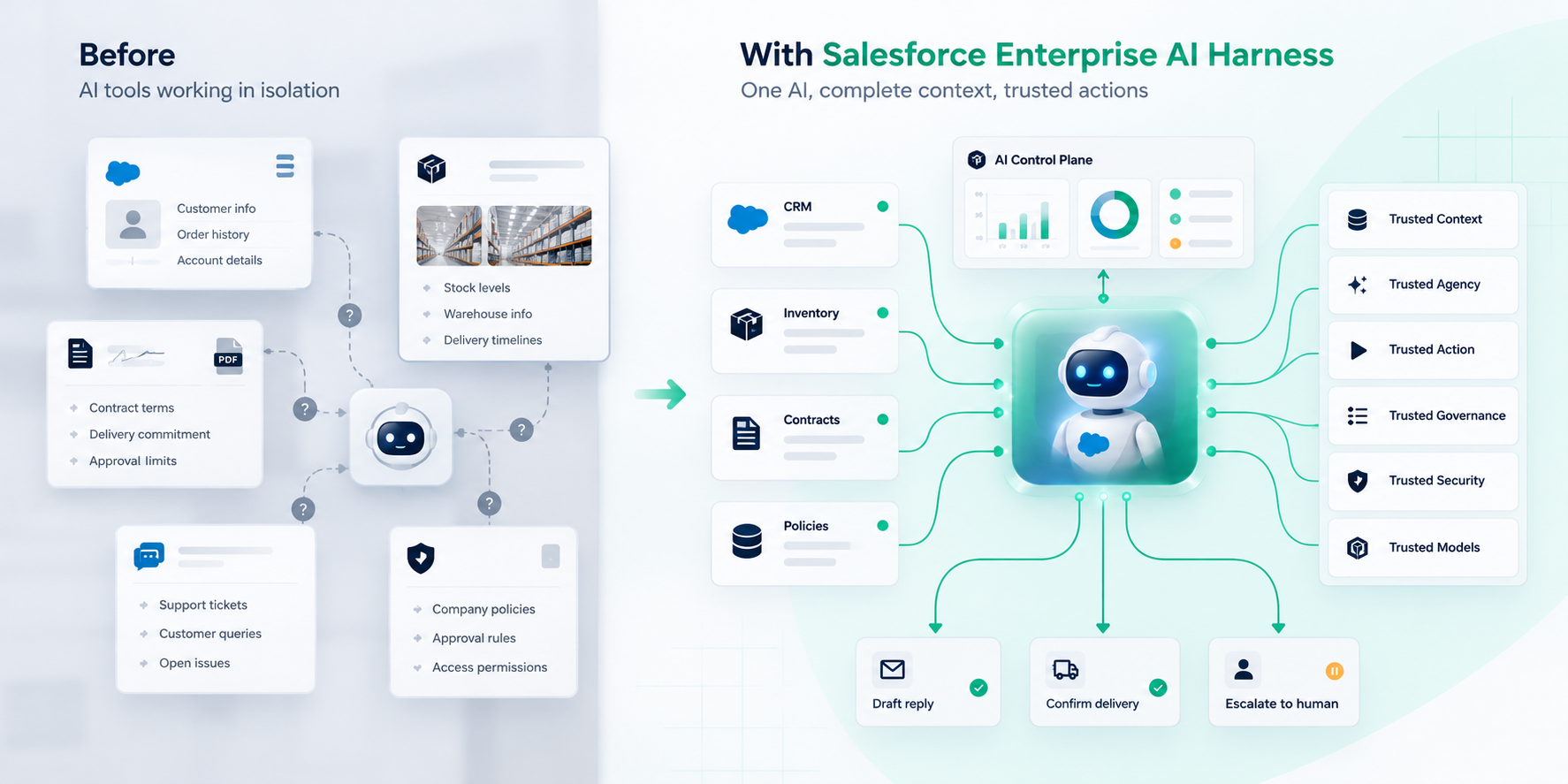
The Enterprise AI Harness is a foundation that sits around your AI, giving every AI agent the same understanding of your business and the same rules about what it is allowed to do. Salesforce announced it on 10 September 2026, ahead of Dreamforce.
It helps to drop the word “harness” for a moment and think about hiring instead.
When a new employee joins, you do not just hand them a desk. You give them access to the right systems, explain how your business works, tell them what they can approve on their own, and show them who to escalate to. The job description is the easy part. Everything around it is what makes them useful and safe.
AI agents need the same thing. The harness is that surrounding setup: the context, the permissions, the business rules, and the record of what the agent did.
Salesforce groups this into six areas: context, agency, action, governance, security, and models. Above them sits an AI Control Plane, a single place to see which agents are running, what each one is allowed to do, how it is performing, and what it costs.
One point worth being clear about. Salesforce says many of the underlying technologies are available today, drawn from products like Data 360, MuleSoft, Agentforce, Tableau and Salesforce Guardian. The unified experience and the new capabilities are planned to start rolling out in early fiscal year 2028, and packaging and pricing have not been published yet. So this is partly a product and partly a direction of travel.
No, and it is worth saying so plainly.
If you are running one AI use case with one team, you do not need an enterprise architecture to support it. You need that use case to work. Starting small is the honest answer for most businesses.
The question is really about which problem you have right now.
| Start with a single AI agent when | Look at a broader AI setup when |
|---|---|
| One team has one clear bottleneck | Several teams are each buying their own AI tools |
| The work sits inside one or two systems | Answers depend on data spread across many systems |
| You are still testing whether AI helps | AI has proved useful and you want to scale it |
| Nobody is asking governance questions yet | You cannot say what your AI tools are allowed to do |
| The cost is small and visible | AI spend is growing and nobody owns the total |
A useful self-check: if you cannot name every AI tool running in your business, who approved it, and what customer data it can reach, that is the signal. Not the technology itself, but the loss of visibility.
Most businesses move through both stages anyway. The agent comes first. The foundation becomes worth building when a second and third agent arrive and you notice they do not agree with each other.
Most of the value in this work comes before any software is configured. It comes from picking the right first problem.
At Cloudespacio, we work with business owners to look at where time actually goes, which processes break most often, and what your Salesforce setup can already support. Sometimes the answer is a single agent handling one workflow. Sometimes it is cleaning up data and permissions first, because an agent built on messy records simply makes mistakes faster.
We will tell you when the answer is to wait. Several of these capabilities are still rolling out, and there is no benefit in paying for architecture you will not use for a year.
The Enterprise AI Harness is a useful idea even if you never buy it: AI is only as good as the context and the limits you give it.
For most business owners, the next step is not an architecture decision. It is choosing one process that frustrates your team every week and seeing whether AI can take it on properly.
If you would find it helpful to talk that through, Cloudespacio is happy to look at your current Salesforce setup and give you an honest read on what is worth doing now and what can wait.
Simple answers to common questions about Salesforce Enterprise AI Harness.
It is the shared foundation around your AI agents: the business context they work from, the permissions that limit them, and the controls that record what they did. It is an architecture rather than a single product you switch on.
Partly. Salesforce says many of the underlying technologies are available now, while new capabilities and the unified experience are planned to begin rolling out in early fiscal year 2028. Packaging and pricing have not been announced.
The name says enterprise, but the underlying idea applies at any size. Smaller businesses can start with one AI agent working on one business workflow instead of adopting a full architecture.
Not necessarily as a new purchase. Much of the foundation comes from Salesforce products you may already have. Start by reviewing what your existing setup can support.

Cloudespacio is a trusted Salesforce implementation partner headquartered in India, helping businesses transform sales, service, manufacturing, automotive, and customer operations with Salesforce.
Copyright © 2026 Cloudespacio Software Pvt. Ltd. All Rights Reserved.
