
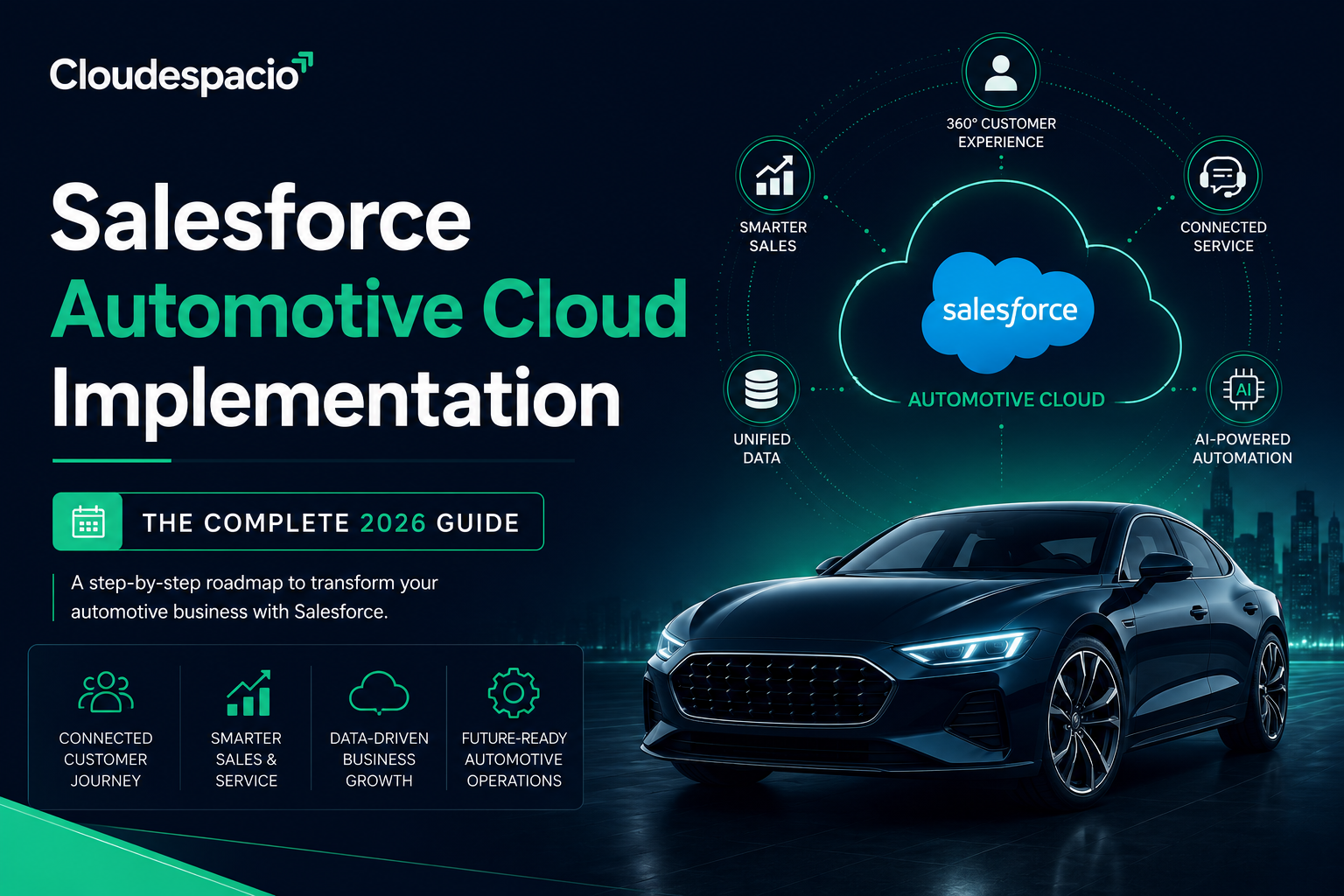
A Salesforce Automotive Cloud implementation done right turns scattered dealer, vehicle, and customer data into a single, AI-ready system that sells more cars, services more drivers, and retains more customers. Done wrong, it becomes an expensive CRM that nobody trusts. This guide walks you through exactly how to get it right in 2026 the phases, the timeline, the costs, the new AI capabilities, and the mistakes that quietly derail most projects.
Whether you’re an OEM trying to see across your dealer network, a multi-location dealership group consolidating sales and service, or a fleet and finance provider managing thousands of vehicles, this is your end-to-end playbook.
Quick answer: A Salesforce Automotive Cloud implementation is the structured rollout of Salesforce’s industry-specific automotive CRM covering discovery, data modeling, configuration, integration, testing, training, and go-live. A typical project runs 8–20 weeks depending on scope, and is best delivered in phases (start with one high-value use case, then expand). The platform unifies driver, vehicle, and dealer data, and in 2026 ships with built-in Agentforce AI agents for sales, finance, and service.
Salesforce Automotive Cloud is an industry-specific CRM built on the Salesforce platform that unifies customer, vehicle, and dealer data into a single source of truth for the automotive value chain. Launched in October 2022 and built on top of Sales Cloud and Service Cloud, it extends standard Salesforce with an automotive data model, prebuilt workflows, and purpose-built features for managing vehicles, drivers, households, and dealer networks.
Instead of forcing automotive businesses to bend a generic CRM to fit, Automotive Cloud Salesforce already understands the relationships that define the industry a single customer who owns multiple vehicles, leases through a fleet account, and services across different dealerships. That focus is what separates true automotive CRM software from a horizontal platform you have to heavily customize.
In 2026, Salesforce positions the product as “Agentforce Automotive” the same platform, now with autonomous AI agents embedded across the sales, finance, and service journeys. You can read the official capabilities on the Salesforce Automotive Cloud product page.
When buyers compare automotive CRM software, a few things make Salesforce Automotive Cloud stand out as the best CRM for automotive operations. (For a side-by-side look at how it stacks up against other platforms, see our automotive CRM comparison.)
For most enterprise automotive businesses, the question isn’t whether Salesforce is capable it’s whether your Salesforce Automotive Cloud implementation is scoped and executed well enough to realize that capability.
The biggest shift this year is AI in automotive industry workflows moving from dashboards to action. Salesforce’s Agentforce layer brings autonomous and assistive AI agents directly into automotive processes. Highlights from the 2026 releases include:
The strategic takeaway: a 2026 implementation should be designed to be agent-ready from day one. Clean, unified data in the Automotive Data Model and Salesforce Data Cloud is the fuel AI agents run on which is exactly why the data-modeling phase of your project matters more than any single feature toggle. (For a deeper dive into the agent layer, see our guide to Agentforce for Automotive.)
A successful Salesforce Automotive Cloud rollout is built on these foundational components:
| Component | What it does |
|---|---|
| Vehicle 360 / Vehicle Console | Unified lifecycle record for every vehicle (history, value, service, warranty) |
| Automotive Data Model | Connects accounts, contacts, vehicles, drivers, and dealers as one graph |
| Automotive Lead Management | Routes high-value leads to the right dealership with full customer/vehicle context |
| Dealer Network Management | Manages dealer hierarchies, regional performance, and visibility rules |
| Connected Vehicle / Telematics | Turns real-time vehicle events into automated CRM actions |
| Analytics for Automotive | Prebuilt dashboards for sales, service efficiency, and revenue trends |
| Agentforce Automotive | AI agents for sales, finance, and proactive service |
The platform also aligns with STAR (Standards for Technology in Automotive Retail) and integrates with Dealer Management Systems (DMS), inventory tools, and finance systems.
Here is the phased process that consistently produces a stable, adoptable system. Treat each phase as a gate don’t move forward until its exit criteria are met. If you’d rather hand this off, our Salesforce implementation services team runs each of these phases end to end.
Define the business outcomes before touching configuration. Map current systems, pain points, and KPIs.
Exit criteria: A signed-off scope, prioritized use cases, and a measurable definition of success.
This is where most projects are won or lost. Shape the Automotive Data Model around your real-world relationships.
Exit criteria: A documented data model, migration plan, and governance rules.
Configure first; customize only when configuration genuinely can’t meet the requirement.
Exit criteria: Configured environment matching the agreed use cases.
Connect Automotive Cloud to the systems it must live alongside.
Exit criteria: Verified, tested integrations with clean data flowing both directions.
Exit criteria: UAT sign-off from business users, not just the project team.
Adoption is a people problem, not a technology problem.
Exit criteria: Trained users who can complete their core workflows unaided.
Exit criteria: Stable operation, KPIs trending in the right direction, and a roadmap for phase two.
How long does a Salesforce Automotive Cloud implementation take? A focused, single-use-case pilot can go live in 8–12 weeks, while a multi-region, multi-system enterprise rollout typically runs 4–9 months across multiple phases.
Cost drivers to budget for:
A phased approach spreads investment over time and lets early wins fund later phases.
Note: The implementation timeline presented in this article is intended as a general reference based on typical Salesforce Automotive Cloud implementation projects. Actual timelines may vary depending on factors such as project scope, business requirements, organization size, data quality, integration complexity, customization needs, stakeholder availability, resource allocation, and implementation methodology. A detailed project schedule is typically finalized during the discovery and planning phase.
Note: Implementation costs can vary significantly based on licensing requirements, project scope, integrations, customization, data migration complexity, organizational size, geographic location, and partner engagement. A comprehensive cost estimate should be developed following a detailed discovery and solution assessment.
Note: Salesforce Automotive Cloud editions, features, licensing, and product capabilities are subject to change. Always refer to the latest Salesforce documentation or consult an authorized Salesforce Partner for the most up-to-date product and licensing information.
Note: The integration examples mentioned in this article (such as Dealer Management Systems, telematics platforms, finance systems, inventory platforms, and marketing solutions) are provided for illustrative purposes only. Actual integration requirements will depend on each organization’s existing technology landscape and business processes.
Note: The implementation best practices outlined in this guide represent commonly recommended approaches based on industry experience. Organizations should tailor these recommendations to their unique business objectives, operational processes, regulatory requirements, and digital transformation strategy.
Disclaimer: This article is intended for informational and educational purposes only and reflects general Salesforce Automotive Cloud implementation practices. Every organization has unique business requirements, technical environments, compliance obligations, and project objectives. Implementation strategies, timelines, costs, integrations, and expected outcomes should be validated through a detailed discovery assessment before project execution. Salesforce product features, licensing, and implementation methodologies may evolve over time; therefore, organizations should always refer to the latest Salesforce documentation or work with an experienced Salesforce implementation partner to ensure the most accurate and up-to-date guidance.
What is Salesforce Automotive Cloud? Salesforce Automotive Cloud is an industry-specific CRM built on the Salesforce platform that unifies driver, vehicle, and dealer data into one system. It extends Sales Cloud and Service Cloud with an automotive data model and purpose-built features, and in 2026 includes built-in Agentforce AI agents.
How long does a Salesforce Automotive Cloud implementation take? A single-use-case pilot can go live in 8–12 weeks. A multi-region enterprise rollout usually takes 4–9 months, delivered in phases to reduce risk.
Is Salesforce the best CRM for automotive? For OEMs, dealership groups, fleets, and automotive finance providers that need vehicle, customer, and dealer data connected in one place, Salesforce Automotive Cloud is widely regarded as a leading choice because of its purpose-built data model, Vehicle 360, and native AI agents.
How is Automotive Cloud different from standard Salesforce CRM? Standard Salesforce is organized around people and deals. Automotive Cloud adds vehicles, drivers, households, dealer hierarchies, warranties, and connected-vehicle data as native records so you’re not building the automotive layer from scratch.
What role does AI play in the automotive industry through Automotive Cloud? In 2026, Agentforce Automotive embeds AI agents across sales (Sales Concierge), finance (Funding Analyst Workbench and AI-assisted collections), and service (proactive maintenance), turning data into automated action rather than just dashboards.
What does a Salesforce Automotive Cloud implementation cost? Cost depends on licensing (by edition and user count), implementation services, integration complexity, data migration, and training. A phased approach lets you spread investment and fund later phases with early wins.

Cloudespacio is a trusted Salesforce implementation partner headquartered in India, helping businesses transform sales, service, manufacturing, automotive, and customer operations with Salesforce.
Copyright © 2026 Cloudespacio Software Pvt. Ltd. All Rights Reserved.
