
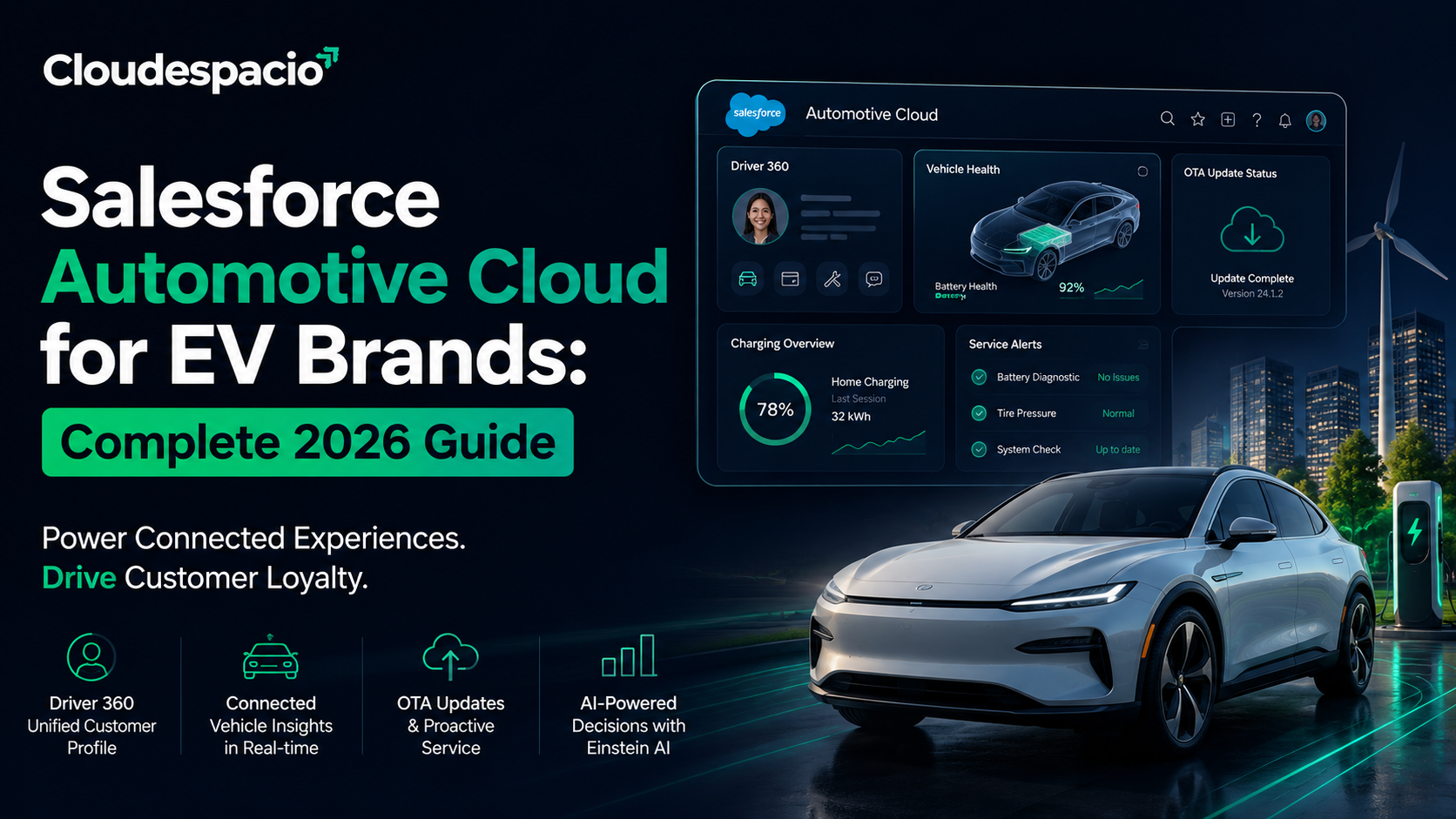
The electric vehicle market is scaling faster than most legacy CRM systems can handle. Global EV sales surpassed 17 million units in 2024, and analysts project that number will nearly double by 2028. As competition intensifies, EV brands that win on product specs alone are quickly finding that customer experience is becoming the real differentiator.
Traditional automotive CRM systems were built around dealership-centric, internal combustion engine (ICE) workflows service intervals tied to mileage, lead routing to franchised dealers, and reactive customer communication. The same tools often marketed as the best automotive CRM for car dealerships, or as automotive CRM software for OEMs, were never designed for the EV operating model. For EV brands operating direct-to-consumer models, managing over-the-air (OTA) software updates, and handling battery health inquiries, these legacy tools fall short by design.
Salesforce Automotive Cloud was built to close exactly that gap. This guide covers the core Salesforce Automotive Cloud features, its specific benefits for EV manufacturers, what a structured implementation looks like, and how your organization can position this platform to deliver measurable returns on customer experience and operational efficiency.
This complete guide covers everything EV brands need to know about Salesforce Automotive Cloud for EV brands from core features and data models to implementation timelines and pricing.
Salesforce Automotive Cloud is an industry-specific solution built on the core Salesforce platform. It extends standard CRM capabilities with automotive-native data models, pre-built workflows, and AI-powered tools designed for OEMs, fleet operators, dealerships, and increasingly EV-first brands operating outside the traditional dealer model. As of late 2025, Salesforce Automotive Cloud is now branded Agentforce Automotive, so if you are wondering what is Agentforce Automotive, it is the same platform with a deeper layer of AI agents built in.
The Problem It Solves for EV Brands
EV manufacturers face a distinct operational profile compared to legacy automakers:
Salesforce Automotive Cloud maps to each of these realities with specific data models, automation tools, and integration frameworks.
How It Differs from Standard Salesforce CRM
The Salesforce Automotive Cloud vs Sales Cloud question comes up often: while standard Salesforce Sales Cloud or Service Cloud can be customized for automotive use cases, Automotive Cloud arrives with:
Understanding the platform’s architecture its Salesforce Automotive Cloud data model explained in practical terms, including the household and driver model helps technical and business stakeholders set accurate expectations before beginning an implementation.
Driver 360 Profile
Driver 360 is the central customer record in Automotive Cloud. Unlike a standard CRM contact, it consolidates data from multiple sources including connected vehicle data into the Salesforce CRM record into a single actionable profile. For EV brands, this means a customer’s vehicle configuration, charging behavior, service history, software subscription status, and communication preferences are all accessible from one view.
Key capabilities include:
Vehicle Console
The Vehicle Console provides a structured record for each vehicle in the fleet or customer portfolio. For EV manufacturers, this goes beyond static VIN data:
Actionable Relationship Center (ARC)
ARC is a visual relationship mapping tool that surfaces connections between customers, vehicles, households, dealers (where applicable), and service histories. For EV brands managing fleet customers or corporate accounts with multiple vehicles, ARC reduces the time your team spends piecing together account context from disconnected records.
The platform is designed to support the full EV customer journey, not just the point of sale.
Pre-Purchase and Order Management
Direct-to-consumer EV sales models require a different lead management approach than dealership-routed sales. Automotive Cloud supports online configurator integration, multi-step order workflows, and deposit management within a single system. Your sales team can track a prospect from initial vehicle configuration through financing approval, delivery scheduling, and home charger installation coordination all within the same record.
Einstein AI surfaces lead scoring and next-best-action recommendations at each stage. If a prospect configures a vehicle but abandons the checkout flow, the system triggers an automated follow-up sequence without manual intervention from your team.
Post-Purchase Engagement and Connected Vehicle Services
For EV brands, the relationship deepens after delivery. Automotive Cloud’s integration framework connects to telematics platforms via REST APIs, and where a dealer model still applies, automotive CRM integration with the DMS keeps service records aligned. Vehicle health data is pulled into the service layer, and when a battery diagnostic flag is raised, the system can automatically create a service case, send proactive vehicle service reminders from Salesforce, notify the customer through their preferred channel, and schedule a remote diagnostic or mobile service appointment all without a customer-initiated contact.
OTA update deployments can be tracked at the fleet level, with customer notifications automated through Marketing Cloud integration. This keeps your customer communications accurate and reduces call center volume from customers asking about update status.
Retention and Lifecycle Marketing
Marketing Cloud integration enables EV brands to run lifecycle campaigns that are triggered by vehicle data, not just calendar dates. A customer approaching the end of a software subscription receives a renewal offer. A customer whose battery SoH drops below a defined threshold receives proactive service outreach. A lease customer at month 30 receives a personalized trade-in offer based on their current vehicle’s residual value and their configuration history a workflow that sits inside Automotive Cloud trade-in management.
Einstein AI for Predictive Service
Einstein’s predictive models in Automotive Cloud are pre-trained on automotive data patterns, which reduces the time required to build useful models from scratch. For EV brands, this means:
Omnichannel Customer Engagement
EV customers interact with brands across more touchpoints than traditional automotive customers mobile apps, in-vehicle screens, web portals, social channels, and physical service centers. As an automotive CRM with vehicle service management built in, Automotive Cloud with Service Cloud provides a unified case management layer across all of these channels, so your agents always have a complete interaction history regardless of where the previous contact occurred.
Flow and Process Automation
Salesforce Flow available natively within Automotive Cloud allows your operations team to automate complex multi-step processes without custom code. Common EV use cases include delivery milestone notifications, charging issue escalation workflows, recall management communications, and warranty claim routing.
Reduced Time-to-Value Through Industry-Specific Configuration
Building an automotive-grade CRM on a generic platform requires significant custom development often 12 to 18 months of engineering before the system reflects your actual business model. Automotive Cloud’s pre-built data models, workflow templates, and AI models cut that timeline substantially. Most EV brands working with an experienced Salesforce Automotive Cloud implementation partner can reach a production-ready state within 4 to 9 months, depending on integration complexity.
This matters because the EV market is moving quickly. A faster implementation cycle means faster time to data quality, faster adoption, and faster ROI on your platform investment.
Unified Data Reduces Operational Silos
Many EV brands operate with customer data spread across a marketing automation platform, a telematics provider, an order management system, and a service ticketing tool. Automotive Cloud serves as a connective layer not necessarily replacing every specialized tool, but centralizing the customer and vehicle record so your teams operate from a consistent data foundation.
Customer-facing teams stop wasting time reconciling information across systems. Service agents see the full customer picture. Marketing teams run campaigns on accurate behavioral data rather than lagging demographic proxies.
EV Startup Scaling Direct Sales: A growth-stage EV brand launching in multiple markets used Automotive Cloud to manage online order queues, delivery logistics coordination, and post-delivery onboarding sequences. By integrating their vehicle telematics platform with Vehicle Console, they reduced inbound service calls by 22% in the first six months through proactive outreach before customers experienced issues.
Fleet Electrification Programs: A commercial vehicle electrification company used Automotive Cloud’s fleet management capabilities to manage multi-vehicle accounts, track state-of-charge and route data across hundreds of vehicles, and generate SoH reports for fleet operators on renewal cycles. The unified data model reduced their account management overhead by approximately 30%.
Automotive OEM EV Division: A traditional automaker’s EV division used Automotive Cloud to build a direct customer relationship layer that operated alongside (not through) their existing dealer network. Managing the dealer network in Salesforce alongside direct relationships showed why an automotive CRM for dealerships on Salesforce and a direct-to-consumer model can run on the same platform. Driver 360 enabled the brand to own the customer data relationship and run lifecycle marketing campaigns independent of dealer participation.
Challenges and Considerations
Data Integration Complexity: Connecting telematics APIs, order management systems, and financial services platforms to Automotive Cloud requires structured integration architecture. Without a clear data governance plan, the unified record can become inconsistent, which undermines the value of the platform. Budget for integration design as a primary workstream, not an afterthought.
Change Management and Adoption: Automotive Cloud introduces new workflows and data practices that affect sales, service, and marketing teams simultaneously. Organizations that underinvest in training and adoption planning typically see utilization rates below 50% in the first year, which significantly delays ROI. Plan for structured enablement programs alongside the technical implementation.
License Cost Modeling: Automotive Cloud carries industry-specific licensing costs on top of base Salesforce licenses. The total Salesforce Automotive Cloud implementation cost depends on your edition, add-ons, and integration scope, and because Salesforce rarely publishes list pricing, teams researching Salesforce Automotive Cloud pricing for 2026 or Agentforce Automotive pricing should request a tailored quote. Model your full license requirements including Marketing Cloud and Data Cloud if applicable before finalizing budget projections. If you run captive lending, note that Salesforce Automotive Cloud for captive finance and broader CRM for automotive finance companies adds modules such as the Funding Analyst Workbench, which carry their own licensing. A consulting partner can help you right-size the license structure to your actual use cases.
Start with a Data Audit
Before configuring the platform, map your existing customer, vehicle, and transaction data across all source systems. Identify duplicates, gaps, and inconsistencies. The quality of your Driver 360 profile depends entirely on the quality and completeness of the data you migrate into it. A data audit phase of 4 to 6 weeks before technical configuration begins will save significantly more time later.
Document ownership of each data domain clearly. Who owns the vehicle record? Who owns the charging behavior data? Who is responsible for data quality ongoing? These questions need organizational answers before they have technical ones.
Phase Your Implementation by Customer Journey Stage
Attempting to configure every module of Automotive Cloud simultaneously extends timelines and dilutes focus. Structure your implementation in phases aligned to the customer journey: Phase 1 covers acquisition and order management, Phase 2 covers post-delivery engagement and service, Phase 3 covers lifecycle marketing and AI activation. Each phase delivers measurable value independently, and user feedback from earlier phases informs later configuration decisions.
Deeper Data Cloud Integration
Salesforce Data Cloud the company’s real-time CDP is increasingly central to how Automotive Cloud delivers personalization and AI-driven action. As EV brands generate larger volumes of telemetry and behavioral data, Data Cloud’s ability to harmonize and activate that data at scale becomes more important. The roadmap for Automotive Cloud shows tighter native integration between Vehicle Console, Driver 360, and Data Cloud, which will reduce the custom integration work currently required to connect high-volume vehicle data streams.
Agentforce for Automotive Customer Service
Salesforce’s Agentforce platform its AI agent layer is being extended with automotive-specific capabilities, and the Agentforce Automotive features now include a Sales Concierge for automotive buying journeys. If you are weighing Agentforce Automotive vs Automotive Cloud, remember they are the same product after the rebrand, now with agents layered on top. For EV brands, common Agentforce Automotive use cases include autonomous AI agents that handle charging support inquiries, service scheduling, and basic diagnostic triage without human agent involvement, and the same Agentforce for Automotive dealerships capabilities extend to franchise service teams. Early deployments in 2025 showed deflection rates of 35 to 45% for routine service contacts. As these models mature through 2026, they will become a standard component of EV customer service operations built on the Salesforce platform.
Salesforce Automotive Cloud gives EV brands the data infrastructure, automation capabilities, and AI tooling needed to manage the full customer lifecycle at scale from digital order to connected vehicle service to long-term retention. Its industry-specific architecture reduces the custom development burden that comes with adapting a generic CRM to automotive realities.
For EV manufacturers competing on customer experience as much as product, a unified and intelligent customer platform is not a differentiator it is a baseline requirement. The brands that build this capability early will have a structural advantage in data quality, operational efficiency, and customer lifetime value as the market matures.
The window to build that foundation efficiently is now. The platform is mature, the integration ecosystem is broad, and the competitive pressure to deliver superior customer experience is real and increasing.
If your organization is evaluating Salesforce Automotive Cloud or planning an implementation, working with a partner who combines Salesforce technical expertise and automotive industry knowledge will reduce risk and accelerate your path to measurable outcomes. Cloudespacio brings both to every engagement.
Salesforce Automotive Cloud for EV brands is no longer optional it is the infrastructure layer that separates market leaders from laggards
Salesforce Automotive Cloud is an industry-specific CRM platform built on the Salesforce platform, designed to manage the full automotive customer lifecycle from lead generation to vehicle purchase, service, and retention. It includes pre-built data models, AI-driven insights, and integrations tailored to OEMs, dealerships, and EV brands.
EV manufacturers benefit through direct-to-consumer sales model support, connected vehicle data integration, charging ecosystem management, and real-time service notifications. The platform enables EV brands to manage software updates, battery diagnostics, and customer communications from a single system of record.
Key features include Driver 360 (a unified customer profile), Vehicle Console (a complete vehicle history view), Journey Builder for EV lifecycle communications, Einstein AI for predictive service recommendations, and omnichannel engagement tools for managing interactions across mobile, web, and in-vehicle touchpoints.
Salesforce does not publish fixed list pricing for the platform, so the Salesforce Automotive Cloud implementation cost depends on your edition, the number of licenses, the add-ons you enable, and integration scope. Teams comparing Salesforce Automotive Cloud pricing for 2026 or Agentforce Automotive pricing should request a tailored quote, and a consulting partner can help right-size the license structure before you commit budget.

Cloudespacio is a trusted Salesforce implementation partner headquartered in India, helping businesses transform sales, service, manufacturing, automotive, and customer operations with Salesforce.
Copyright © 2026 Cloudespacio Software Pvt. Ltd. All Rights Reserved.
