
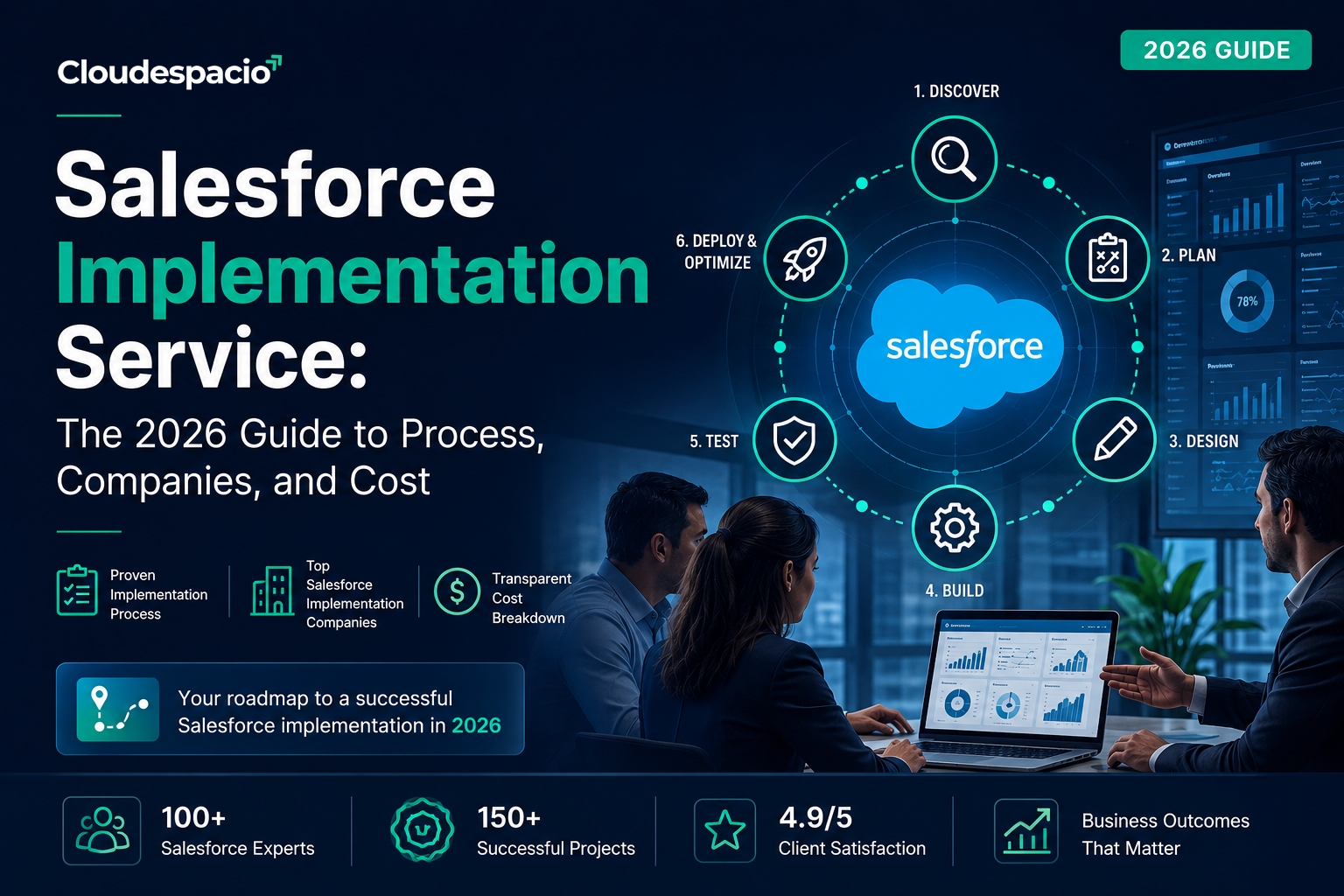
Every year, thousands of companies buy Salesforce licenses and then discover an uncomfortable truth: the platform does not configure itself. A professional Salesforce implementation service is what turns those licenses into a CRM your team actually uses. Choosing between the many Salesforce implementation companies competing for your project, while keeping your Salesforce implementation cost under control, is where the real work begins. This guide walks you through all three, so you can plan your project with confidence.
Quick answer: A Salesforce implementation service is an end-to-end professional engagement that plans, configures, customizes, integrates, tests, and launches Salesforce around your business processes. In 2026, Salesforce implementation cost typically runs $5,000 to $25,000 for small businesses, $25,000 to $150,000 for mid-size companies, and $150,000 to $500,000 or more for enterprises. Certified partners with global delivery models routinely cut that spend by 30 to 50 percent compared to onshore-only teams.
A Salesforce implementation service is the structured, expert-led process of deploying Salesforce for a specific business. It covers analyzing your requirements, designing the data and security architecture, configuring the platform, building custom functionality where needed, migrating legacy data, connecting Salesforce to your other systems, training your users, and supporting the org after launch.
Out of the box, Salesforce is a powerful but blank canvas. It has no idea what your sales stages look like, which fields your reps need on a lead, how a support case should escalate, or which approvals a discount requires. An implementation service molds the platform around the way your company actually works, so that Salesforce accelerates your processes instead of forcing your team to fight the tool.
The distinction matters commercially too. Salesforce sells you the software. A Salesforce implementation partner delivers the outcome: adopted users, clean data, connected systems, and reports leadership can trust.
Salesforce leads the global CRM market, and its ecosystem now stretches across Sales Cloud, Service Cloud, Marketing Cloud, Commerce Cloud, Revenue Cloud, Data Cloud, and AI agents through Agentforce. That breadth is exactly why do-it-yourself rollouts so often stall. Industry analysts have reported for years that a large share of CRM projects underdeliver, and the cause is almost never the software. It is unclear requirements, messy data, and users who were never brought along.
A professional Salesforce implementation service protects you from those failure modes and delivers measurable advantages:
When you compare proposals from different Salesforce implementation companies, verify that each of these eight deliverables is explicitly in scope. Vague proposals that skip line items are the most common source of surprise invoices later.
Salesforce is a family of products, and each cloud carries its own implementation considerations. A strong partner helps you sequence them into a roadmap instead of selling everything at once.
Most experienced partners recommend launching on Sales Cloud or Service Cloud first, proving ROI within a quarter, and only then expanding into marketing, commerce, and AI capabilities on a phased plan.
A disciplined salesforce implementation process is what separates a smooth launch from a stalled one. Here is the eight-stage methodology most experienced Salesforce partners follow:
Simple single-cloud projects complete in 3 to 8 weeks. Mid-size implementations with migrations and integrations take 2 to 6 months. Enterprise multi-cloud programs run 6 to 12 months or longer.
Salesforce implementation cost in 2026 ranges from about $5,000 for a basic small-business setup to more than $500,000 for complex enterprise programs. The spread is wide because “implementation” can mean a two-week quick start or a year-long transformation across multiple clouds, custom applications, and a dozen integrations.
| Business Size | Typical Implementation Cost | Typical Timeline |
|---|---|---|
| Small business (1 to 25 users) | $5,000 to $25,000 | 3 to 8 weeks |
| Mid-size business (25 to 200 users) | $25,000 to $150,000 | 2 to 6 months |
| Enterprise (200+ users) | $150,000 to $500,000+ | 6 to 12+ months |
These figures cover professional services only. Salesforce license fees are separate, starting at $25 per user per month for the Starter Suite and rising to several hundred dollars per user per month for advanced editions.
| Component | Typical Share of Budget | Indicative Range (mid-size project) |
|---|---|---|
| Consulting and discovery | 10 to 15% | $3,000 to $15,000 |
| Configuration and customization | 30 to 40% | $10,000 to $60,000 |
| Data migration | 10 to 15% | $3,000 to $20,000 |
| Integrations | 15 to 25% | $5,000 to $40,000 |
| Training and change management | 5 to 10% | $3,000 to $15,000 |
| Go-live support and stabilization | 5 to 10% | $2,000 to $10,000 |
If one quote is dramatically cheaper than the rest, check this table against its scope. The discount usually hides a missing component, most often migration, training, or post-launch support, which you end up buying later at a premium.
First-year budgets fail most often because they only cover licenses and the build. Plan ahead for data cleanup effort, paid AppExchange apps, storage and sandbox add-ons, scope creep from mid-project requests, and ongoing administration. Managed support with a partner typically runs $2,000 to $5,000 per month, far below the $70,000-plus annual salary of a full-time in-house Salesforce admin.
Exhaust standard features before writing custom code. Clean your data before migration starts, not after. Launch in phases so each stage funds confidence in the next. Lock a written scope with a clear change-request process. And choose a Salesforce implementation partner whose delivery model, not whose corner-cutting, produces the savings.
Thousands of consulting firms are registered in the Salesforce ecosystem, from single freelancers to global system integrators. Selecting between Salesforce implementation companies is the single highest-leverage decision in your project, so evaluate every shortlist against these eight criteria:
Global system integrators fit multinational, highly complex programs but bring premium rates and layered teams. Boutique and mid-size certified partners deliver senior-level attention, faster decisions, and stronger value, which makes them the best fit for most small and mid-market businesses. Freelancers suit isolated small tasks, not full implementations where accountability and breadth of skills decide the outcome.
Be cautious with any firm that quotes a fixed price before running discovery, cannot name its certified staff, has no documented post-launch plan, or answers every requirement with custom code. Each of these patterns predicts budget overruns and a fragile org.
Most budget overruns trace back to the same avoidable decisions. Skipping discovery produces a build that matches nobody’s workflow and gets rebuilt within a year. Migrating dirty data destroys user trust on launch day and forces an expensive cleanup under pressure. Over-customizing before processes stabilize creates technical debt that taxes every future change. A big-bang launch across all departments multiplies risk that a phased rollout would have contained. Ignoring training and change management leaves adoption to chance, and adoption is the entire point. Finally, choosing the cheapest bid usually means paying twice: once for the discount build, and again for the partner who fixes it later. Rescue projects like these are common across the industry, and nearly every one costs more than doing it right the first time would have.
Before committing to any Salesforce implementation service, make sure you can answer these questions with confidence: Does the proposal itemize every component in the cost breakdown table above, or does it bundle everything into one vague number? Have you verified the partner’s certifications on the AppExchange directory rather than taking their word for it? Do you know exactly who, by name and seniority, will be on your project team? Is there a written plan for training, change management, and support after go-live, or does the engagement quietly end at deployment? A partner that welcomes these questions is usually the right one. A partner that deflects them is a warning sign worth taking seriously.
A Salesforce implementation service is a professional engagement that deploys Salesforce end to end for your business: requirement analysis, solution design, configuration, customization, data migration, integration, user training, and post-launch support, delivered by certified consultants.
Salesforce implementation cost typically ranges from $5,000 to $25,000 for small businesses, $25,000 to $150,000 for mid-size companies, and $150,000 to $500,000 or more for enterprises. The final figure depends on clouds in scope, customization, data complexity, integrations, and consultant rates. License fees are billed separately by Salesforce.
A basic single-cloud setup goes live in 3 to 8 weeks. Mid-size projects with data migration and integrations take 2 to 6 months. Complex multi-cloud enterprise rollouts require 6 to 12 months or longer.
Salesforce implementation companies analyze your requirements, design the architecture, configure and customize the platform, migrate your data, integrate Salesforce with other systems, train your users, and support the org after launch so it keeps delivering value.
For a very simple single-cloud setup with an experienced in-house admin, yes. In practice, most self-implemented orgs accumulate architecture mistakes, low adoption, and technical debt that cost more to repair than a certified partner would have cost upfront.
The biggest drivers are custom development, the number of clouds in scope, complex integrations, poor-quality legacy data, and scope creep from requirements added after the project starts.
Small teams usually start with Starter or Pro Suite, while growing and mid-size businesses choose Enterprise Edition for its automation depth, API access, and customization. A discovery session with an implementation partner pins down the right edition before you spend on licenses.
Ask how many certified consultants and architects will actually work on your project, request case studies from your industry, get an itemized cost breakdown rather than a single lump sum, and confirm what support looks like in the first 90 days after go-live. Vague answers to any of these are a signal to look elsewhere.

Cloudespacio is a trusted Salesforce implementation partner headquartered in India, helping businesses transform sales, service, manufacturing, automotive, and customer operations with Salesforce.
Copyright © 2025 All Rights Reserved. Designed by Navpatra.
