AI-Powered Warranty and After-Sales Service for Manufacturers
AI Warranty and After-Sales Service: A Salesforce Guide for Manufacturers
Quick answer: AI warranty and after-sales service means using one connected platform, such as Salesforce Manufacturing Cloud, plus AI agents to register assets, check warranty coverage, process claims, dispatch technicians and recover costs from suppliers with far less manual work. Manufacturers use it to pay fewer wrong claims, fix machines faster, and turn service from a cost centre into a steady revenue stream.
You sold the machine. The invoice is paid. For many B2B manufacturers, that is where the real work starts.
A dealer emails a warranty claim with blurry photos. A customer calls because a pump stopped on the line. Your service team digs through ERP screens, spreadsheets and old emails to answer one question: is this covered? Meanwhile the customer waits, and the cost keeps rising.
This guide explains, in plain language, how AI warranty and after-sales service works on Salesforce. It covers what the system does, how it works under the hood, why it matters now, and who on your team benefits. It is written by Cloudespacio, a Salesforce and AI consulting firm that helps manufacturers build connected service operations.
Why do warranty and after-sales service matter more in 2026?
Warranty costs are rising. In 2025, U.S.-based manufacturers paid $30.37 billion in warranty claims, and their reserves jumped 17% in a single year (Warranty Week, April 2026).
Warranty metric, U.S.-based manufacturers
2025 value
Change vs 2024
Warranty claims paid
$30.37 billion
+4%
Warranty accruals set aside
$33.41 billion
+7%
Warranty reserves held at year end
$71.89 billion
+17%
Average claims rate (claims as % of product sales)
1.30%
Full-year average
Average accrual rate (accruals as % of product sales)
What this means in simple terms: for every $100 of product you sell, about $1.30 goes back out as warranty claims. On a $50 million product line, that is roughly $650,000 a year. Even a small cut in wrong or slow claims protects real margin.
The pressure is not even across industries:
Vehicles and heavy equipment: the vehicle sector paid $20.81 billion in claims in 2025, 69% of the U.S. total. Warranty Week links rising vehicle-sector accruals to higher parts and labour costs and the threat of tariffs and labour shortages (source).
Automakers in 2026: U.S. automakers hit a new record high for claims paid and reserves held in Q2 2026 (Warranty Week, Sept 2026).
Electronics and chips: semiconductor and PCB makers paid $1.53 billion in claims in 2025, double 2024 (source).
At the same time, service teams are stretched. Salesforce’s State of Field Service report, published July 30, 2026, surveyed 2,317 field service professionals across nine countries (Salesforce News):
95% already use some form of AI, and 85% plan to raise AI investment in the next one to two years.
57% of teams using AI for scheduling and dispatch see higher revenue per job.
66% say mobile worker turnover has gone up in the past two years.
61% say technicians lack access to the customer data they need on site.
Only 16% run field and back-office technology on one platform.
The takeaway for a business owner: warranty is a growing cost, service skills are scarce, and disconnected data is the main blocker. AI only helps once the data is connected.
What are the 6 warranty and service problems most B2B manufacturers face?
Most manufacturers do not have a warranty problem. They have a data problem that shows up as a warranty problem.
Warranty data lives in many places. Serial numbers sit in the ERP, contracts in PDFs, service history in a technician’s notebook. Salesforce’s own Trailhead training notes that warranty extensions and restrictions are often “recorded in rough notes and purchase receipts” and that it is “laborious to consolidate the required claims information from disparate systems” (Trailhead).
Claims are checked by hand. An adjuster reads each dealer claim, looks up coverage, checks labour hours and approves or rejects. It is slow and inconsistent, and wrong claims slip through.
Dealers and distributors are kept in the dark. Partners email or call to ask “where is my claim?” because they cannot see status themselves. Trailhead names this too: “Partners struggle to track the status of their warranty claims.”
Supplier recovery is skipped. When a supplier’s part caused the failure, the cost should be charged back to that supplier. Without clean failure data, much of that money is never claimed.
Technicians arrive without context. They do not know the asset history, which parts are covered, or whether a recall applies. That means repeat visits.
Service revenue is left on the table. Expiring warranties are not renewed, and extended warranty or service contracts are never offered at the right time.
How Salesforce and AI handle warranty and after-sales service
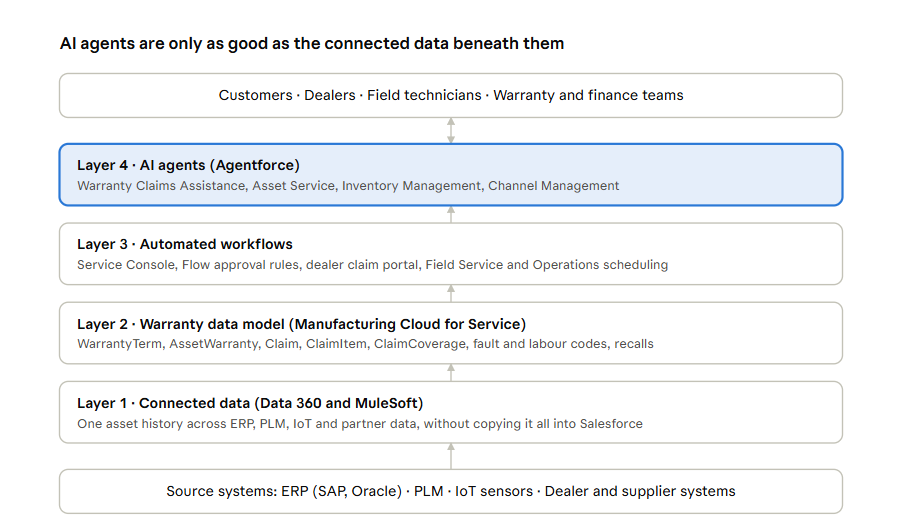
Salesforce solves this with four layers that work together: a connected data layer, a warranty data model, automated workflows, and AI agents on top. Think of it like a factory: raw materials (data), a production line (workflows), and smart operators (AI agents).
Data flows up from your source systems. People work with the AI agents at the top, and every agent answer is grounded in the layers below.
Layer 1: Connect the data (Data 360 and MuleSoft)
What it does: brings customer, product, asset and sensor data from your ERP, PLM and IoT systems into one governed view, without copying everything into Salesforce (Salesforce for Manufacturing).
How it works: MuleSoft provides ready connectors, including SAP, to pull orders, serial numbers and part data. Data 360 then links records so one machine has one history, from shipment to every repair.
Why it matters: an AI agent is only as good as the data it reads. Salesforce states its manufacturing agents are grounded in a data model that connects CRM, ERP, IoT and distributor systems (Salesforce).
Layer 2: Model warranties properly (Manufacturing Cloud for Service)
What it does: stores every warranty rule and every claim as structured data, not as PDFs and emails. Salesforce sells Manufacturing Cloud for Service as the Service Core, Service Max, and Sales & Service Max editions.
A plain-English guide to the key warranty objects and what they represent.
Object
Plain-English meaning
WarrantyTerm and WarrantyTermCoverage
The warranty programme itself: duration, usage limits, what is covered
ProductWarrantyTerm
Which products come with which warranty programme
AssetWarranty
The warranty attached to one specific machine, including exclusions and extensions
Claim
A warranty claim from a dealer, or a recovery claim you send to a supplier
ClaimItem
The defective machine that needs repair or replacement
ClaimCoverage and ClaimCoveragePaymentDetail
The faulty part, how much is covered, and what gets paid
ProductFaultCode, ProductLaborCode, CodeSet
Standard codes for faults and repair labour, so claims are comparable
ProductServiceCampaign
Recalls and service campaigns across a fleet of assets
Why it matters: when coverage is data, software can check it in seconds. You can define programmes by duration, usage limits and covered parts, and set business rules to auto-approve claims, for example by labour hours (Salesforce).
Layer 3: Automate the workflow (Service Cloud, Flow, Field Service and Operations)
What it does: moves each claim and service job from step to step without manual chasing.
How it works: the Service Console gives agents a 360-degree view of an asset, with its warranties, cases, work orders and claims in one screen. It raises alerts for upcoming warranty renewals and asset issues, and suggests next actions such as creating a claim, selling an extended warranty, or booking a visit (Salesforce). Dealers and customers can submit claims themselves through a portal or API. Field Service and Operations then schedules the right technician. According to midcai’s Dreamforce 2026 recap, Salesforce’s Scheduling Agent 2.0 can use customer history, asset information, warranties, technician skills, SLAs and business rules to find the right appointment (midcai recap).
Layer 4: Add AI agents (Agentforce)
What it does: AI agents talk to customers, dealers and staff, and take actions inside Salesforce.
How it works: Salesforce offers prebuilt manufacturing agent templates (Salesforce):
Warranty Claims Assistance: handles claim intake, eligibility checks and status checks across the full claims lifecycle.
Asset Service: monitors asset health, schedules maintenance and coordinates field teams.
Inventory Management: balances spare parts across service locations and distributors to avoid stock-outs.
Channel Management: gives channel partners payout insights and warranty management.
Salesforce’s Summer ’26 release for manufacturing includes an AI Warranty Concierge that guides customers through a claim end to end. Its Winter ’27 release adds a Warranty Claims Adjudication Agent that validates coverage and flags potential fraud (Salesforce Manufacturing Cloud). At Dreamforce 2026, Salesforce also highlighted Casey, its prebuilt customer service agent, according to Coastal. Teams can customise any agent with Agentforce Builder (low-code) and Agentforce Script (natural-language authoring).
Why it is safe: agents run on the Einstein Trust Layer. Salesforce states your data is not used to train third-party models, agents respect existing user permissions, and every agent action is auditable (Salesforce).
Step by step: how an AI-powered warranty claim works on Salesforce
Here is the full journey of one claim, from the day the machine ships to the day the supplier pays you back.
Register the asset. When a machine ships, its serial number becomes an asset record, and Salesforce can attach the right warranty using the link between the product and its warranty programme (ProductWarrantyTerm to AssetWarranty), once your registration flow is set up.
Report the problem. A customer or dealer reports a fault on a partner portal, by email, or by chat. An AI agent collects the serial number, symptoms and photos, and opens a case. No forms to chase.
Check eligibility in seconds. The agent reads the asset’s warranty record: is it in date, under the usage limit, and not excluded? It also checks for open recalls (ProductServiceCampaign). The answer goes back to the customer straight away.
Fix it right the first time. Field Service and Operations books a technician with the right skills and confirms the parts are in stock. On site, the technician sees the full asset history on mobile and logs standard fault and labour codes.
Approve the claim. Business rules you configure can auto-approve standard claims that fall inside set limits, such as normal labour hours. Unusual claims, for example labour far above the standard time, can be routed to a human adjuster.
Pay the dealer and recover from the supplier. The approved amount is calculated and paid. If a supplier’s part caused the failure, you can create a supplier recovery claim from the same claim data (the Claim object supports both dealer and supplier claims).
Learn and sell. Failure trends by part, plant and batch flow to engineering and quality teams. Warranties nearing expiry trigger renewal or extended-warranty offers for sales.
Who on your team benefits from AI warranty and after-sales service?
Every team that touches a product after the sale gets something concrete.
Warranty Operations | Before and After AI on Salesforce
Warranty Operations: Before and After AI on Salesforce
How connected Salesforce capabilities change the experience across warranty roles.
Role
Before
After AI on Salesforce
Owner / CEO
Warranty cost is a surprise line in the P&L
Live view of claims, cost per claim and supplier recoveries
Warranty manager / adjuster
Reads every claim by hand
Reviews only flagged exceptions; standard claims auto-approve
Service head
Firefights escalations
Proactive alerts on asset health and expiring warranties
Field technician
Arrives without history or parts
Full asset history, coverage and parts on mobile
Dealer / distributor
Emails to ask “where is my claim?”
Submits and tracks claims on a portal or by chat
End customer
Waits days for an answer
Gets coverage and next steps in minutes
Quality / engineering
Gets failure data months late
Sees failure trends by part and batch as they happen
Finance
Struggles to estimate reserves
Cleaner claim data for accruals and supplier chargebacks
Industries where this is most relevant: industrial machinery and heavy equipment, automotive and auto components, HVAC and appliances, electrical and electronics, medical and scientific equipment, power and energy equipment, and any manufacturer that sells through dealers or distributors.
What results can manufacturers expect, and which KPIs should they track?
Salesforce states that one global manufacturer automated 60% of its warranty claims, and its manufacturing page also cites 21% faster case wrap-up and 30% ROI, based on its Manufacturing Customer Success Survey and customer stories (Salesforce for Manufacturing). These are vendor-reported figures, and results vary by data quality and scope.
To prove value in your own business, measure these before and after go-live:
Warranty KPIs | Salesforce
Warranty Performance KPIs
Key measures for tracking warranty operations and their Salesforce data sources.
KPI
What it tells you
Where it comes from in Salesforce
Claim cycle time (days)
How fast dealers and customers get paid or answered
Claim created date to approved date
Auto-approval rate (%)
Share of claims approved without a person
Claims approved by business rules vs total
Cost per claim
Admin effort spent on each claim
Adjuster time and claim volume in reports
Supplier recovery rate (%)
Money won back from suppliers vs eligible
Supplier recovery claims vs causal-part claims
First-time fix rate (%)
Jobs fixed in one visit
Work orders closed without a repeat visit
Claims rate (% of product sales)
Warranty cost vs revenue; compare with the 1.30% U.S. average
Claims paid vs product revenue
Warranty and service contract revenue
How much service turns into profit
Renewals and extended warranties sold
A practical tip from Salesforce partner Coastal after Dreamforce 2026: pick a few use cases tied to a number you already track, such as warranty claim cycle time, and pilot before you scale (Coastal).
How Cloudespacio builds AI warranty and after-sales service on Salesforce
Cloudespacio starts with your data and one measurable outcome, then adds AI agents only when the foundation is ready. Our five-phase approach:
Discover and baseline. We map how a claim moves today, from dealer email to payment, and record your current claim cycle time, auto-approval rate and supplier recovery rate. This becomes the scorecard for ROI.
Connect the data. We integrate your ERP (SAP, Oracle, Microsoft Dynamics or others), serial number data and service history into Salesforce using MuleSoft and Data 360, and clean up asset and warranty records.
Configure Manufacturing Cloud for Service. We set up warranty programmes, claim objects, fault and labour codes, approval rules, and a dealer portal for self-service claims.
Launch AI agents on a pilot. We deploy and tune the Warranty Claims Assistance and Asset Service agents for one product line or region, with clear human handoff rules and guardrails.
Scale and optimise. We extend to field service scheduling, supplier recovery, recalls and service contract renewals, and review KPIs every month.
Why manufacturers work with Cloudespacio: we combine Salesforce implementation, AI agent design and manufacturing process know-how, and we speak business language, not just tech language. Our goal is simple: fewer wrong claims, faster fixes, and more service revenue.
Frequently Asked Questions
AI warranty and after-sales service is the use of connected data and AI agents to run everything that happens after a product is sold: warranty registration, claims, repairs, spare parts, recalls and service contracts. On Salesforce, it combines Manufacturing Cloud for Service, Field Service and Operations, Data 360 and Agentforce.
Warranty lifecycle management is the full process of handling a product warranty, from registering the asset and defining coverage, to processing claims, paying dealers, recovering costs from suppliers, and analysing failures. On Salesforce, Manufacturing Cloud for Service manages these steps on one platform.
AI can help reduce warranty costs by checking eligibility, flagging unusual claims with the right rules, and supporting supplier recovery. It also cuts admin time, because standard claims can be approved by rules and AI agents can answer status questions.
Yes. Manufacturing Cloud for Service lets you set business rules that auto-approve claims within limits, and the prebuilt Warranty Claims Assistance agent handles claim intake, eligibility checks and status checks. Salesforce reports that one global manufacturer automated 60% of its warranty claims.
Service Cloud is Salesforce's general customer service platform for cases, channels and knowledge. Manufacturing Cloud for Service adds manufacturing-specific parts on top: asset and warranty objects, claims, supplier recovery, fault and labour codes, and prebuilt manufacturing AI agents.
Yes. Salesforce connects to SAP, Oracle and other ERPs through MuleSoft connectors, and Data 360 can use ERP, PLM and IoT data without moving all of it into Salesforce. Your ERP stays the system for finance and inventory; Salesforce runs the customer and service side.
Salesforce agents run on the Einstein Trust Layer. According to Salesforce, your data is not used to train third-party AI models, agents follow your existing user permissions and sharing rules, and every agent action is logged for audit.
As listed on Salesforce's Manufacturing Cloud pricing page in October 2026, Service Core starts at $275 USD per user per month (billed annually), Service Max is $650, and Sales & Service Max is $700. Prices and editions vary by region, so confirm current pricing with Salesforce or Cloudespacio.
No. Mid-sized manufacturers can benefit too, especially when a small warranty team handles a large claim volume by hand. Start with one product line and one KPI, such as claim cycle time.
Start by measuring your current claim cycle time, auto-approval rate and supplier recovery rate. Then connect your asset and warranty data, configure Manufacturing Cloud for Service, and pilot one AI agent. Cloudespacio can run this as a structured engagement.