
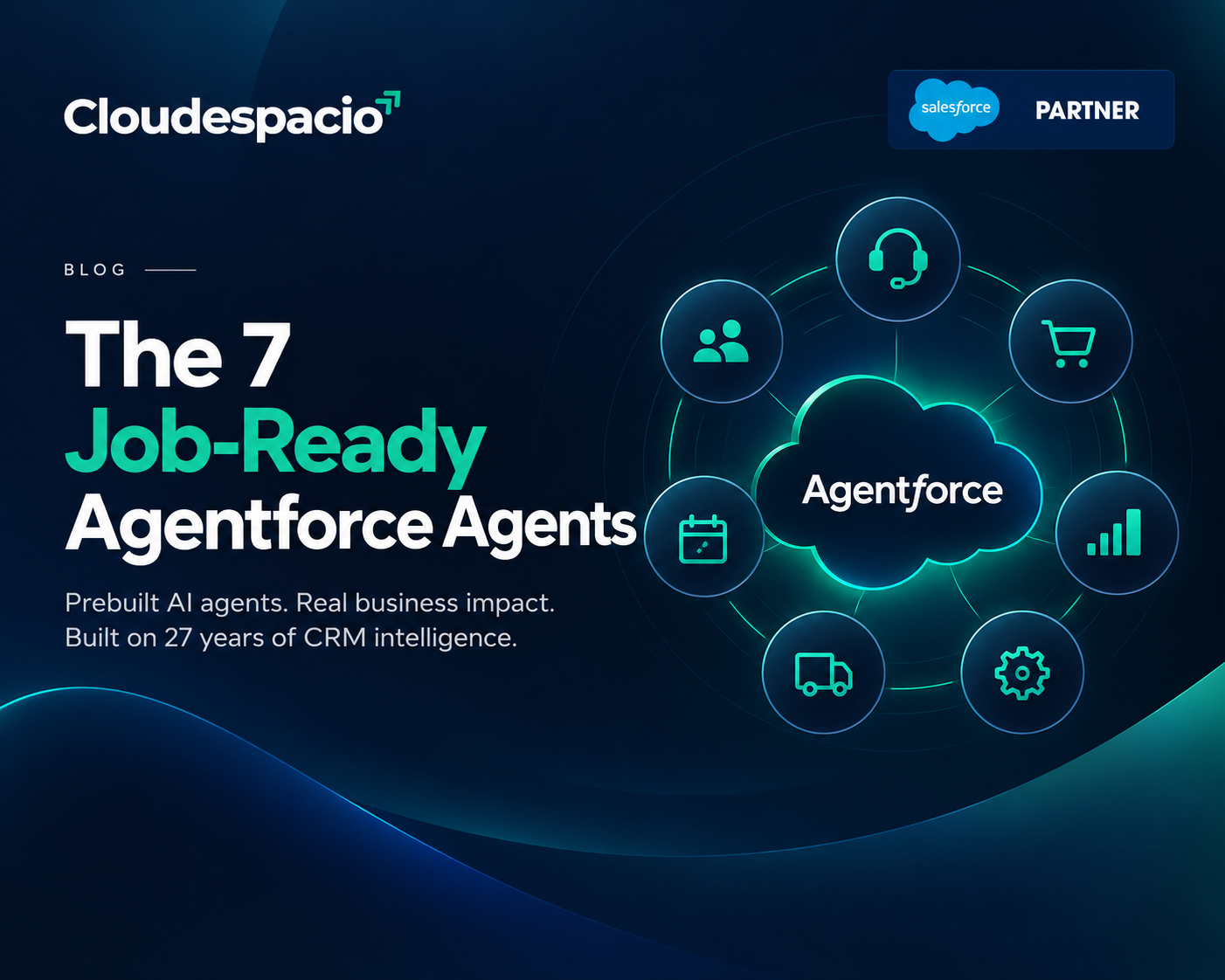
On September 11, 2026, Salesforce introduced seven job-ready agents for Agentforce: Casey (customer service), Paige (IT and HR), Carter (shopping), Hunter (outbound sales), Marshall (supply chain), Piper (inbound pipeline) and Fin (customer experience). Six are generally available now. Hunter is in pilot, with general availability planned for November 2026
Job-ready agents are prebuilt Agentforce agents, each designed for one business function such as customer service, IT support or outbound sales. Instead of starting with a blank agent, a company starts with one that already covers the job, then tailors it to its own rules, permissions and processes.
This is a real change in approach. Until now, most Agentforce projects meant defining topics, actions and instructions from the ground up. With the new portfolio, the job definition comes first and customization comes second. Salesforce points to two years of work alongside customers across thousands of agentic deployments as the basis for the launch.
Every agent operates within the customer’s business rules, permissions and security. For finer control, teams can use Agent Script, Salesforce’s open-source language for agent behavior, to combine AI reasoning with deterministic rules.
| Agent | Role | Where It Works | Status |
|---|---|---|---|
| Casey | Help Agent (Customer Service) | Voice, SMS, WhatsApp, Web Chat | Generally Available |
| Paige | IT and HR Service Agent | Slack, Portals, Employee Tools | Generally Available |
| Carter | Shopper Agent | Product Discovery, Comparison, In-Chat Checkout | Generally Available |
| Hunter | Outbound Sales Agent | Sales Pipeline, Alongside Sellers | Pilot · GA Planned Nov 2026 |
| Marshall | Supply Chain Agent | End-to-End Back-Office Processes | Generally Available |
| Piper | Inbound Pipeline Agent | Websites and Inboxes | Generally Available |
| Fin | Customer Agent (CX) | Every Customer Channel | Generally Available |
Casey resolves customer service issues across voice, SMS, WhatsApp and web chat. It comes with prebuilt support for FAQs, returns, account management and escalation to a human. As an example of the results Salesforce cites, Engine’s help agent, Eva, fully resolves 50% of the company’s chat inquiries.
Best for: support teams with high volumes of repeat questions.
Paige handles employee requests inside Slack, internal portals and the tools staff already use, from IT issues to HR questions. Salesforce says Autism Queensland’s employee service agent, Paige, resolves 70% of its administrative requests.
Best for: internal service desks where the same requests arrive every day.
Carter helps shoppers discover and compare products, get questions answered, and complete checkout without leaving the chat. In the same announcement, Salesforce says Hibbett AI handles 90% of core shopper journeys and went live in six weeks. Salesforce does not say which portfolio agent Hibbett AI is built on, so treat it as a related proof point rather than a Carter result.
Best for: ecommerce brands losing buyers between product questions and checkout.
Hunter works a sales pipeline from account research to outreach and collaborates with sellers over weeks and months. Salesforce gives a clear example: a seller asks Hunter to rescue at-risk deals before quarter end. Hunter turns that request into a measurable goal, builds a plan, and follows guardrails that define when it can act on its own and when it needs the seller’s approval. According to Salesforce, 60% of Perk’s sales pipeline is built by Hunter.
Best for: sales teams that need more pipeline per seller. Note that Hunter is in pilot until its planned November 2026 general availability.
Marshall orchestrates end-to-end back-office processes, automates manual work with deterministic execution, and provides an audit record of every action. That audit trail matters for operations teams that must show exactly what happened and why.
Best for: operations and logistics teams running manual, multi-step processes.
Piper engages, qualifies and converts inbound leads across websites and inboxes for B2B sales and marketing teams. Salesforce says Asana’s website agent, Piper, drives 4x the conversation volume, and that customers deploy Piper in 45 days on average.
Best for: B2B companies with steady website traffic that rarely turns into sales conversations.
Fin resolves complex customer experience workflows across every channel. It is powered by Operator, a customer operations agent, and Fin Apex, a set of custom models trained for customer experience. Salesforce says 79% of Anthropic’s own conversations that Fin sees are resolved autonomously. That figure describes one customer’s deployment, not Fin’s performance in general.
Fin did not come from Salesforce’s own labs. Coverage of the launch reports that Fin, formerly Intercom, joined Salesforce through an acquisition valued at roughly $3.6 billion, which closed on September 10, 2026. That detail comes from press coverage, not from Salesforce’s agent announcement.
Best for: CX teams handling complex, multi-step customer issues across many channels.
The long-horizon runtime is a new Agentforce execution layer that lets an agent pursue a goal across days and weeks, instead of finishing only one task or interaction. It rests on three capabilities:
This is what separates these agents from a chatbot or a scheduled workflow. Valuable business work, like winning a deal, rarely fits inside a single chat. Hunter is the first agent on the runtime. Salesforce says more agents in the portfolio will run on it over time, and customers will be able to build long-horizon agents of their own.
| Company | Agent | Result (per Salesforce) |
|---|---|---|
| Engine | Help Agent (Eva) | 50% of chat inquiries fully resolved |
| Perk | Hunter | 60% of sales pipeline built by the agent |
| Autism Queensland | Paige | 70% of administrative requests resolved |
| Hibbett | Hibbett AI | 90% of core shopper journeys handled; live in six weeks |
| Asana | Piper | 4x conversation volume; Piper deploys in 45 days on average |
| Anthropic | Fin | 79% of conversations Fin sees in Anthropic's support resolved autonomously |
These figures come from Salesforce’s own announcement and are not independent audits. Use them as benchmarks to test against during a pilot, not as guarantees.
Start with the job that has the most repetitive, rules-based work and the clearest success metric. A focused first win builds the case for the next agent.
| If Your Biggest Pain Is... | Start With | Track This Metric |
|---|---|---|
| High chat and call volume | Casey | Resolution rate and handle time |
| Repeated internal IT and HR tickets | Paige | Ticket resolution time |
| Shoppers leaving before checkout | Carter | Chat-to-checkout rate |
| Website visitors who never talk to sales | Piper | Qualified meetings booked |
| Manual back-office steps | Marshall | Manual steps removed |
| Thin outbound pipeline | Hunter (Pilot) | Pipeline created per seller |
| Complex multi-channel CX | Fin | Autonomous resolution rate |
Casey (customer service), Paige (IT and HR), Carter (shopping), Hunter (outbound sales), Marshall (supply chain), Piper (inbound pipeline) and Fin (customer experience). Each is a prebuilt Agentforce agent designed for one business function and connected to Customer 360.
On September 11, 2026, in San Francisco, just ahead of Dreamforce 2026.
Hunter is in pilot. Salesforce plans general availability for November 2026. The other six agents are generally available now.
Yes. Salesforce says customers can tailor each agent to their business, including giving it their own name. Engine's help agent, for example, is called Eva.
Salesforce positions them as agents that work within a company's rules, with people in control. Casey includes human escalation, and Hunter works alongside sellers and asks for approval where its guardrails require it. The practical effect is shifting repetitive work away from people, not removing human oversight.
A custom agent starts empty, and your team defines its topics, actions and data. A job-ready agent starts with the skills, actions and data models for its role, so your team focuses on tailoring it rather than building it.
Salesforce did not list per-agent pricing in the announcement. Pricing depends on your edition and usage, so check Salesforce's pricing page or contact Salesforce or an implementation partner for a quote.

Cloudespacio is a trusted Salesforce implementation partner headquartered in India, helping businesses transform sales, service, manufacturing, automotive, and customer operations with Salesforce.
Copyright © 2026 Cloudespacio Software Pvt. Ltd. All Rights Reserved.
