
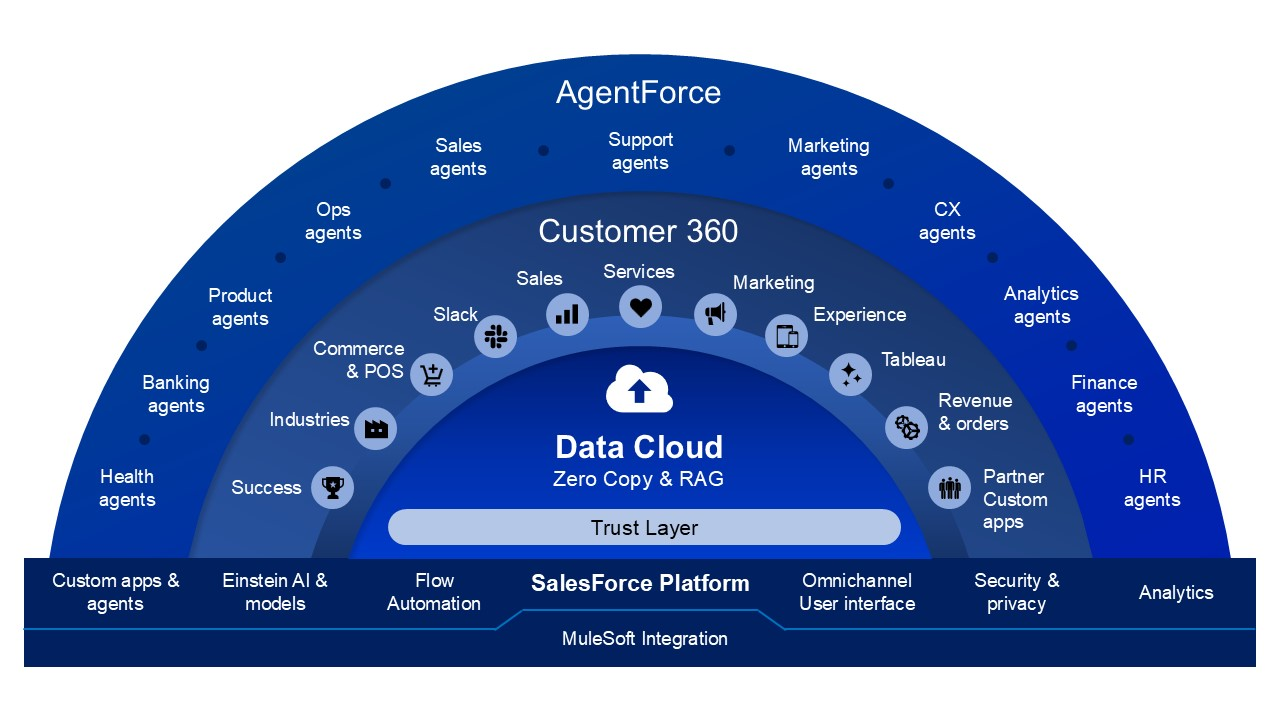
The architecture of a system determines its destiny. For years, CRM architecture was designed to be a static “System of Record”, a place where data sat and waited for a human to interact with it.
Salesforce Agentforce fundamentally redefines this traditional architectural model. It introduces a dynamic, “agentic” architecture that transforms the CRM into a System of Action.
By understanding the underlying layers of this new framework, businesses can move beyond simple automation and enter the era of truly autonomous operations.
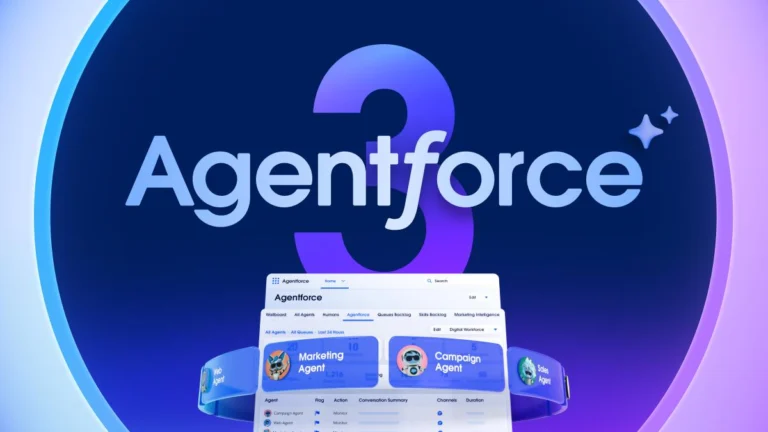
Salesforce Agentforce is a platform that allows you to build a “Digital Workforce.” While we have used chatbots for years, those were limited by rigid scripts and buttons.
Agentforce is different because it is powered by reasoning, meaning it can handle unpredictable human conversations and find its own way to a solution.
When implementing AI at an enterprise scale, the “black box” approach, where you simply send data to an AI and hope for a good result, is dangerous. Architecture provides the necessary guardrails. A well-structured AI architecture ensures that the system is:
Salesforce’s infrastructure has undergone three massive architectural shifts to reach this point. Initially, the focus was on the Multi-tenant Cloud, which allowed for shared resources. Next came the Einstein Layer, which added predictive modeling to specific CRM fields.
Today, we have the Agentforce Framework, which sits on top of the Data Cloud, allowing for a unified, real-time data stream that powers autonomous reasoning across all Salesforce “Clouds.”
To fully understand Agentforce, it should not be viewed as a standalone application, but rather as a comprehensive orchestration framework. It serves as the connective layer that integrates data, business logic (Flows), and user interfaces across channels such as Slack, web, and mobile.
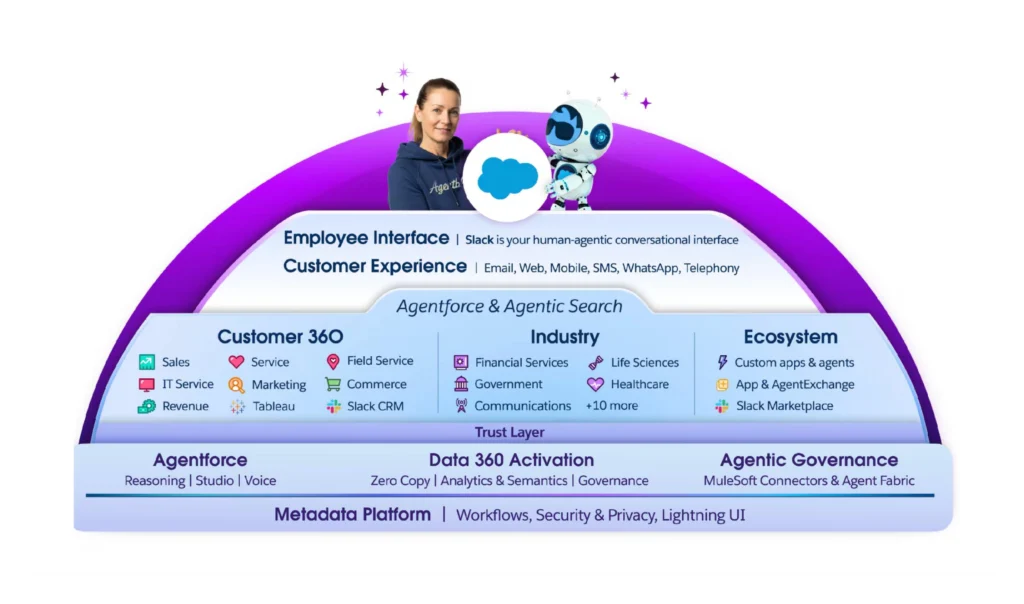
Salesforce Agentforce Architecture is a metadata-driven framework that enables autonomous AI agents to interact with the Salesforce platform. The core concept is “Grounding through Metadata.”
By using the existing descriptions of your fields, objects, and flows, the AI understands exactly what “tools” it has at its disposal and what “rules” it must follow to reach a specific business goal.
The framework is designed to be modular. You don’t have to rebuild your CRM to use it; instead, you “plug in” agents to your existing setup.
The framework consists of several key layers that work in harmony:
The “Stack” of Agentforce is built in a specific hierarchy. Each layer relies on the one below it to function correctly. If the data layer is weak, the intelligence layer will fail. Understanding these layers is essential for any technical architect.
This is the foundation of the entire system, powered primarily by Salesforce Data Cloud. Unlike old architectures where data was siloed in different tables, this layer creates a unified “Customer 360” profile.
It uses Zero-Copy technology, meaning it can “read” data from external warehouses like Snowflake or Google BigQuery without actually moving the data, ensuring the agent always has the most current facts.
This layer is where the Atlas Reasoning Engine lives. Instead of following a rigid “If/Then” script, this layer uses Large Language Models (LLMs) to interpret user intent.
It analyzes the “Grounding” data from the Data Layer to ensure the AI’s response is relevant to your specific business, preventing the “hallucinations” common in generic AI models.
This layer is where the Atlas Reasoning Engine lives. Instead of following a rigid “If/Then” script, this layer uses Large Language Models (LLMs) to interpret user intent.
It analyzes the “Grounding” data from the Data Layer to ensure the AI’s response is relevant to your specific business, preventing the “hallucinations” common in generic AI models.
This layer is where the Atlas Reasoning Engine lives. Instead of following a rigid “If/Then” script, this layer uses Large Language Models (LLMs) to interpret user intent.
It analyzes the “Grounding” data from the Data Layer to ensure the AI’s response is relevant to your specific business, preventing the “hallucinations” common in generic AI models.
Beyond the layers, there are specific “engines” that drive the day-to-day operations of an agent. These components are the building blocks that admins use within the Salesforce Setup menu to configure their digital workforce.
These are the specialized “workers” you deploy. You can have an SDR Agent for sales, a Service Agent for support, and a Merchant Agent for e-commerce. Each agent is given a specific “Job Description” and a set of permissions that limit its scope of action.
We often refer to Data Cloud as the “Heart” of Agentforce. It collects, cleanses, and harmonizes data from every touchpoint. This allows the agent to know, for example, that the person chatting on the website is the same person who opened a support ticket yesterday and looked at a pricing page five minutes ago.
Agentforce does not replace Salesforce Flow; it uses it. The Automation Engine is the collection of “Tools” the agent can call upon. If the reasoning engine decides a customer needs to be re-authenticated, it launches a pre-built Flow to handle that specific task securely.
Connectors allow Agentforce to reach outside the Salesforce ecosystem. Whether it is checking a shipping status on FedEx or updating a row in an Excel sheet, these connectors expand the agent’s “Hands” to work across the entire internet.
The lifecycle of an Agentforce interaction is a rapid, three-part process. It happens in milliseconds but involves a massive amount of cross-platform communication to ensure the result is both helpful and accurate.
To visualize how the system functions under the hood, we must look at the “Flow” of information from the moment of contact to the moment of resolution. This workflow is designed for speed and data integrity.
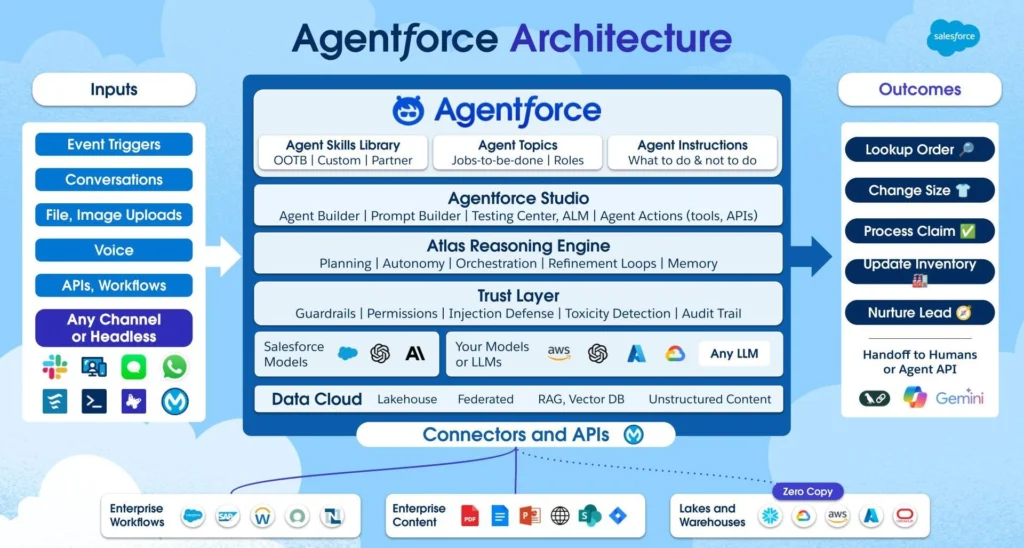
The data flow starts with Ingestion (bringing data into Data Cloud), followed by Harmonization (matching records to a single ID). When an agent is triggered, it performs a Vector Search to find the most relevant “chunks” of information.
After the agent acts, the results are written back into the CRM, completing the cycle and ensuring the “System of Record” is always up to date.
Traditional batch processing where data is updated once a day, is incompatible with Agentforce. The architecture uses a Real-Time Pipeline.
As soon as a customer clicks a button on your website, that “telemetry” data is streamed into the Data Cloud, making it immediately available to the agent for its next reasoning cycle.
The reason architects are excited about this framework is that it solves the “technical debt” problems of the past. By building on a unified metadata layer, Salesforce has created a system that is inherently more stable and scalable than custom-coded AI solutions.
How does this complex architecture translate into business value? Across every industry, the “System of Action” is being used to automate the most expensive and time-consuming parts of the customer lifecycle.
By using the Service Agent, companies can resolve 70-80% of Tier 1 inquiries (like password resets, order tracking, and FAQ handling) without a human.
The architecture ensures that if a case is too complex, the agent hands it over to a human with a full summary of the work done so far.
The SDR Agent uses the architecture to manage lead qualification. It can monitor “Signal Data” (like a lead visiting a pricing page three times) and autonomously reach out to start a conversation, significantly increasing the “Speed to Lead.”
Marketing Agents use the Real-Time Pipeline to trigger hyper-personalized messages. If a customer abandons a cart, the agent can analyze the customer’s previous “LTV” (Lifetime Value) and decide whether to offer a 5% discount or a “Free Shipping” code to win them back.
When comparing the “New Way” to the “Old Way,” the differences are structural. We are moving from a world of “Static Links” to a world of “Dynamic Reasoning.”
Traditional CRM architecture is Linear. You build a screen, a user enters data, and a workflow moves that data to the next screen.
Agentforce architecture is Circular. The AI constantly monitors the data, reasons about what should happen next, and triggers actions in a continuous loop.
No architectural shift is without its difficulties. For Agentforce to work, the organization must be willing to address the “foundational” issues that have plagued IT departments for years.
To ensure a successful rollout, technical teams should follow a “Phased” approach. You cannot automate your entire business on Day 1. You must build the foundation first and then layer the autonomy on top.
Start by defining “Topics” for your agents. Instead of trying to make one agent that knows everything, build “Small, Expert Agents.” This modular design makes it easier to test, debug, and scale as your needs grow.
Before turning on an agent, perform a Data Audit. Ensure that your Data Cloud is correctly ingesting data and that your “Identity Resolution” rules are accurate.
An agent is a “Mirror”, it will reflect the quality of the data you give it.
We are currently in the “Early Adopter” phase of agentic architecture. In the coming years, we will see these systems become more autonomous, more integrated, and more essential to the survival of the modern brand.
The architecture of Salesforce Agentforce represents the “Great Convergence” of data, AI, and automation. By moving away from rigid, code-heavy systems and toward a flexible, metadata-driven framework, Salesforce has provided businesses with the ultimate toolkit for the AI era.
Understanding this architecture is the key to unlocking a new level of productivity, allowing your business to act at the speed of thought.
As the digital workforce becomes a reality, the organizations that master this architectural blueprint will be the ones that define the future of their industries.

Cloudespacio is a trusted Salesforce implementation partner headquartered in India, helping businesses transform sales, service, manufacturing, automotive, and customer operations with Salesforce.
Copyright © 2026 Cloudespacio Software Pvt. Ltd. All Rights Reserved.
