
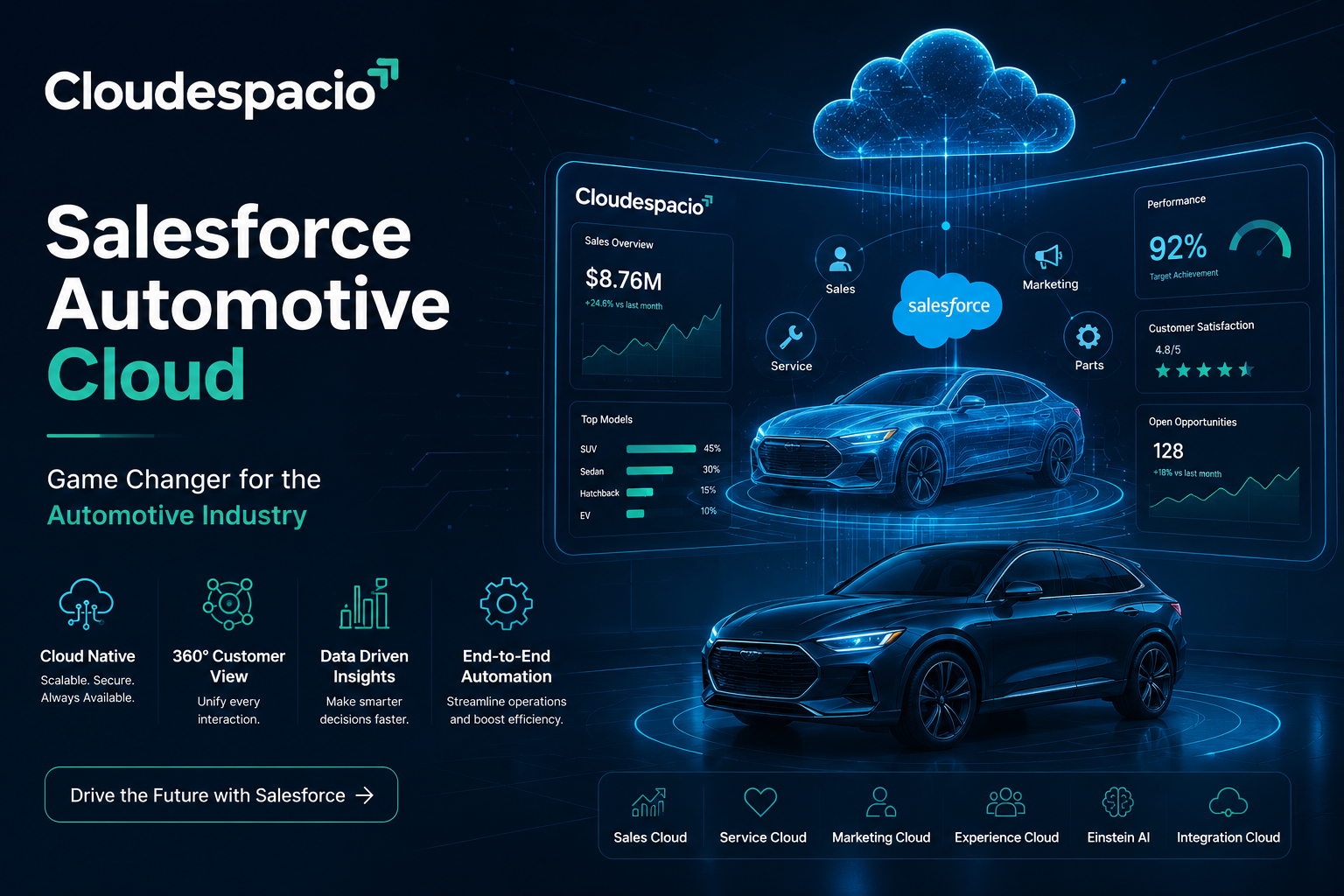
The automotive industry is undergoing one of its most significant transformations in decades. Customers now research vehicles online for weeks before setting foot in a showroom, expect personalized follow-up after every service visit, and increasingly interact with connected vehicles that generate continuous streams of data. Meeting these expectations with disconnected tools is not just inefficient – it is a direct threat to customer retention and revenue.
For years, automotive businesses tried to adapt generic CRM platforms to fit their needs, bolting on spreadsheets, custom fields, and third-party tools to track vehicle inventories, service histories, and dealer relationships. The result was fragmented data, poor visibility across the customer lifecycle, and sales teams operating without the context they needed to close deals or prevent churn.
Salesforce Automotive Cloud changes that equation. Built specifically for original equipment manufacturers (OEMs), dealerships, fleet operators, and automotive finance providers, it brings together customer data, vehicle data, and operational workflows in a single platform. This guide covers what Salesforce Automotive Cloud is, how it works, its core features and benefits, and what to consider before you implement it.
Salesforce Automotive Cloud is an industry-specific CRM solution built on the Salesforce platform. Launched to address the unique operational and data requirements of the automotive sector, it extends the core capabilities of Salesforce Sales Cloud and Service Cloud with automotive-specific data models, prebuilt integrations, and purpose-built features for managing vehicles, households, drivers, and dealer networks.
Rather than forcing automotive businesses to customize a horizontal CRM from scratch, Salesforce Automotive Cloud provides a foundation that already understands concepts like vehicle ownership history, service appointments, dealer hierarchies, and connected vehicle telemetry. It is designed to serve the entire automotive value chain from the manufacturer distributing vehicles through a dealer network to the service advisor scheduling a routine oil change for a loyal customer.
The core Salesforce platform is a powerful general-purpose CRM, but it lacks native support for automotive-specific data relationships. With Automotive Cloud, you get:
Salesforce Automotive Cloud serves several distinct segments of the automotive industry:
Understanding what is included in the platform helps you evaluate how well it maps to your specific business needs. The following components form the foundation of the solution.
Vehicle 360 is arguably the most distinctive feature of Salesforce Automotive Cloud. It creates a single, unified record for every vehicle in your ecosystem, capturing a complete history of that asset across its entire lifecycle.
A Vehicle 360 record can include:
This single record becomes the connective tissue between your sales team, service advisors, and customer success functions. When a customer calls in, every team member sees the full picture immediately.
Automotive relationships are rarely one-to-one. A household may own multiple vehicles. A corporate fleet account may have dozens of drivers assigned across different vehicle classes. Salesforce Automotive Cloud models these relationships explicitly, allowing you to manage accounts, contacts, vehicles, and drivers as an interconnected graph rather than isolated records.
This matters when you are trying to proactively reach the right person at the right moment for example, notifying the fleet manager (not the individual driver) when a lease on five vehicles is approaching its renewal date.
For OEMs and distributors, Automotive Cloud includes tools to manage dealer hierarchies, track performance metrics by location or region, and facilitate communication and inventory sharing between the manufacturer and the dealer network. You can set visibility rules so regional managers see aggregate data while individual dealers see only their own performance and inventory.
The platform operates as a connected layer across your sales, service, and operational data. Here is how the key workflows come to life.
At the center of Automotive Cloud is the idea that every customer and every vehicle follows a predictable lifecycle and that your CRM should support every stage of it proactively, not reactively.
A prospective buyer’s journey starts as a lead when they complete a web form or visit a showroom. As they move through the sales funnel, their record is enriched with vehicle preferences, trade-in details, financing pre-qualifications, and test drive notes. When they purchase, the vehicle record is linked to their account, and ownership data is recorded.
Post-sale, the platform drives service engagement. Automated reminders go out when the vehicle approaches recommended maintenance intervals. If the vehicle is connected, telemetry events can automatically create service cases or prompt outreach from a service advisor. At the end of a lease or financing term, renewal workflows can trigger months in advance, giving your sales team time to present options before the customer starts shopping elsewhere.
One of the more forward-looking capabilities of Salesforce Automotive Cloud is its ability to consume data from connected vehicles. Through API integrations with vehicle telematics platforms, the CRM can receive real-time or near-real-time data events a low fuel warning, a diagnostic trouble code, a mileage milestone and translate those events into CRM actions.
For example, when a connected vehicle reports a fault code that indicates a potential safety issue, the platform can automatically open a service case, identify the nearest authorized service center with available capacity, and send the customer a proactive notification with a pre-filled scheduling link. This moves the dealership from a reactive service model to a proactive one, which research consistently shows drives higher customer satisfaction and service revenue.
Automotive Lead Management extends standard Salesforce lead functionality with automotive-specific qualification fields, lead source tracking for both digital and walk-in traffic, and routing rules that match leads to the right sales associate based on vehicle interest, location, and availability. You can track lead-to-appointment conversion rates and identify which marketing channels are generating the highest-quality prospects.
Key capabilities include:
The service module within Automotive Cloud allows dealerships and OEMs to manage service appointments, repair orders, warranty claims, and recall campaigns from a single interface. Service advisors can see a customer’s full vehicle and relationship history before the appointment even begins.
Highlights include:
Salesforce Automotive Cloud includes prebuilt dashboards and reports tuned to automotive KPIs. Rather than building reports from scratch, you start with templates covering sales pipeline by model, service revenue by location, customer retention rates, and dealer performance scorecards. These can be extended using Salesforce’s native reporting tools or connected to Tableau for deeper analysis.
Out-of-the-box reporting covers:
When you consolidate around Automotive Cloud, every team sales, service, finance, and marketing is working from the same record. A service advisor can see that a customer’s lease ends in 90 days and flag it for the sales team. A marketing campaign manager can exclude customers who are already in an active renewal conversation. These small coordination improvements compound into measurable revenue outcomes over time.
According to Salesforce’s own research, automotive companies that unify their customer data platforms see an average 25% improvement in customer retention metrics within the first year of deployment. While results vary based on implementation quality and organizational readiness, the directional impact of reducing data fragmentation is well documented.
Customers do not think about your organization in terms of departments. They think about whether their overall experience with your brand was worth returning for. Salesforce Automotive Cloud enables a consistent, informed experience at every touchpoint whether the customer is browsing inventory online, speaking with a finance manager, or picking up their vehicle after a service appointment.
Because every team member has access to the same customer and vehicle history, conversations become more relevant and less repetitive. Customers do not need to re-explain their situation every time they call in. Advisors can make recommendations grounded in actual usage patterns rather than generic offers. This quality of interaction builds the kind of trust that translates into repeat purchases and referrals.
Before you configure a single workflow, define what data you need, where it currently lives, and what quality standards it must meet before it enters Salesforce. This includes establishing a master data management approach for vehicle records particularly around VIN standardization and deciding how you will handle historical data from legacy systems.
Engage your data and IT teams alongside your business stakeholders in this phase. The business requirements should drive the data model decisions, not the other way around. A certified Salesforce consulting partner with automotive industry experience can help you avoid common pitfalls in this stage and accelerate the design process significantly.
Not every integration needs to be live on day one. A phased approach that prioritizes the integrations with the highest immediate business impact typically the DMS connection and any marketing automation platforms allows your team to start realizing value earlier while reducing the risk of a complex multi-system go-live.
Document your integration requirements clearly, including data flow direction, synchronization frequency, and conflict resolution rules. These decisions are much harder to change after go-live than before it, so investing time in integration architecture up front pays dividends throughout the platform’s life.
Salesforce has been embedding its Einstein AI capabilities across all its industry clouds, and Automotive Cloud is no exception. The near-term roadmap includes AI-powered next-best-action recommendations for sales and service teams surfacing the most relevant offer or intervention for each customer based on their full history and predictive churn risk models.
As generative AI capabilities mature within the Salesforce platform, automotive businesses will also be able to use tools like Einstein Copilot to draft personalized service follow-up communications, summarize long customer histories for new team members, or generate territory performance narratives for dealer review meetings all from within the CRM interface.
The automotive industry is shifting from a product-centric model toward a mobility and services model, where revenue increasingly comes from ongoing subscriptions, software updates, and service contracts rather than one-time vehicle sales. Salesforce Automotive Cloud is evolving alongside this shift, with expanded support for subscription management, over-the-air software entitlements, and integration with mobility-as-a-service platforms.
As more vehicles become software-defined, the volume of telemetry data flowing into CRM systems will grow substantially. Organizations that build a strong data architecture today with clear vehicle records, connected integrations, and well-defined automated workflows will be best positioned to take advantage of this data as its volume and value increase.
Salesforce Automotive Cloud represents a purpose-built answer to one of the automotive industry’s most persistent challenges: fragmented data that prevents businesses from truly understanding and serving their customers and vehicles across a complete lifecycle. By combining automotive-specific data models, connected vehicle integration, and the full power of the Salesforce platform, it gives OEMs, dealerships, and fleet operators the tools to move from reactive to proactive engagement.
For your business, the practical value shows up in measurable places higher service retention rates, shorter lead-to-sale cycles, more effective recall campaigns, and better coordination across sales and service teams. These are not abstract benefits; they are outcomes driven by giving your people accurate, complete information at the moment they need it.
Looking ahead, the convergence of AI, connected vehicle data, and subscription-based automotive business models will only increase the strategic importance of a unified customer and vehicle platform. Organizations that invest in building that foundation now will have a compounding advantage as the industry continues to evolve.
If you are evaluating Salesforce Automotive Cloud for your organization, working with a consulting partner that specializes in automotive CRM implementations can significantly accelerate your time to value and reduce implementation risk helping you move from evaluation to measurable outcomes faster.
Salesforce Automotive Cloud is an industry-specific CRM platform built on Salesforce, designed to help OEMs, dealerships, and fleet operators manage the full vehicle and customer lifecycle. It integrates sales, service, finance, and connected vehicle data in a single platform, replacing the need for multiple disconnected tools across the automotive value chain.
Unlike standard Salesforce CRM, Automotive Cloud includes automotive-specific data models such as vehicle records, household management, and driver relationships. It also integrates with connected vehicle APIs and dealer management systems natively, which generic CRM platforms do not support out of the box. This means less custom development and faster time to value for automotive businesses.
Salesforce Automotive Cloud is best suited for OEMs, franchise and independent dealerships, fleet management companies, and automotive finance and insurance providers. Any organization that needs to manage the relationship between customers, vehicles, and ongoing service or financial contracts will find the platform's data model more aligned to their needs than a generic CRM.
Implementation timelines vary based on organizational complexity, the number of integrations required, and data migration scope. A focused deployment for a single dealership group can take 3 to 6 months, while an enterprise OEM rollout may span 9 to 18 months. Working with a certified Salesforce consulting partner with automotive industry experience significantly reduces implementation risk and compresses time to value.

Cloudespacio, headquartered in India, is a prominent independent Salesforce and leading consulting firm, dedicated to prioritizing client satisfaction.
Copyright © 2025 All Rights Reserved. Designed by Navpatra.
If you have a project in mind, let’s talk!
