
One of the Market’s Leading Industrial Manufacturers
Food & Beverage (Wine Distribution)
Manufacturing (Industrial & Discrete)
Manufacturing & Distribution
Salesforce Manufacturing Cloud, Data Cloud, Agentforce for Manufacturing, Einstein 1 for Manufacturing, Tableau CRM Analytics, MuleSoft, Experience Cloud, CPQ, Business Rules Engine for Industries
Implementation
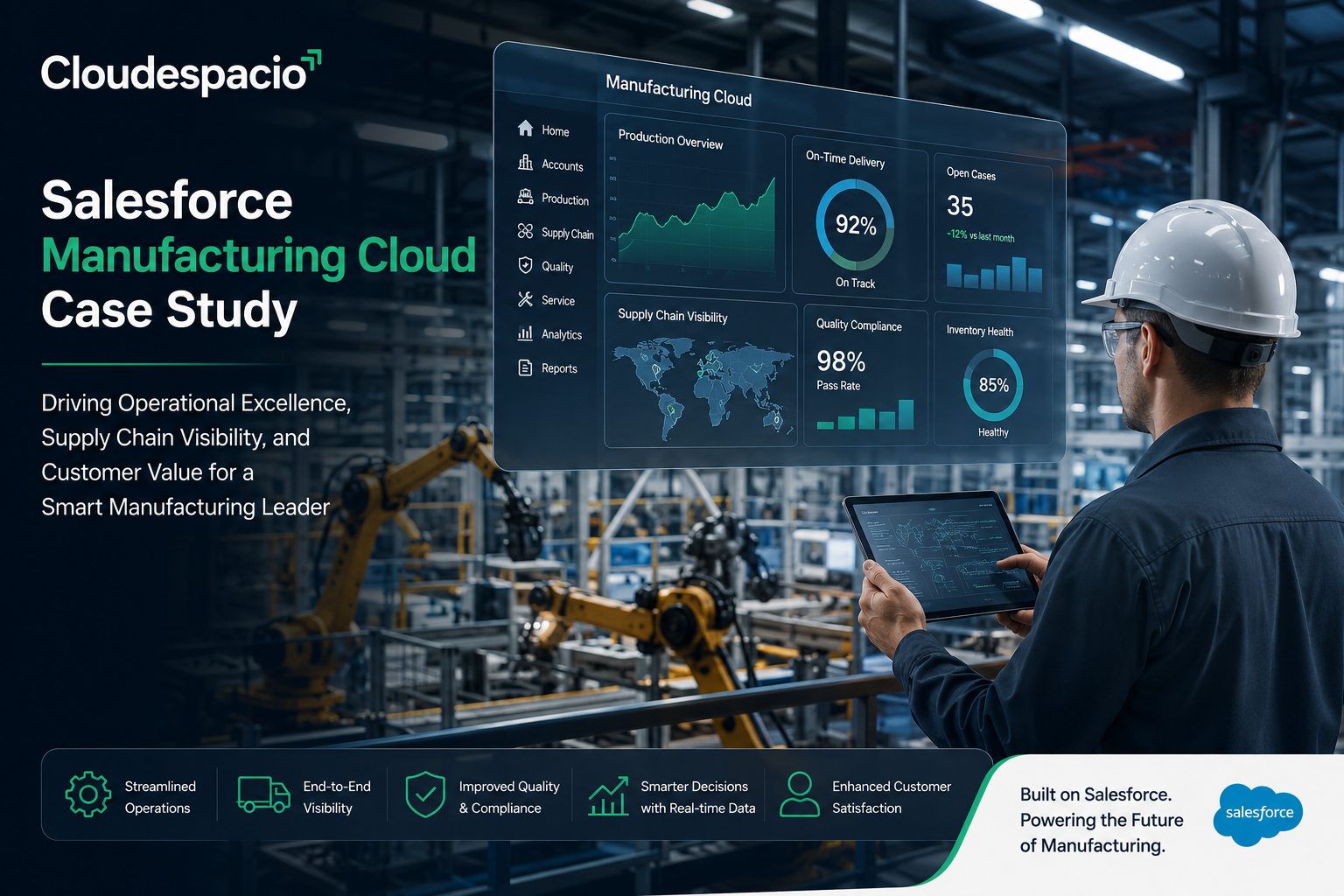
A large industrial manufacturer was growing across product lines and channels, but its sales and operations were pulling in different directions. This Salesforce Manufacturing Cloud case study shows how the company replaced a patchwork of spreadsheets and disconnected tools with one platform built for the manufacturing industry.
Sales agreements lived in spreadsheets. Forecasts were stale the moment they were built. The run-rate business that made up most of their revenue had almost no visibility. Distributors and channel partners operated in the dark, and the service side, from warranty claims to depot repair, ran on entirely separate systems.
They needed a real manufacturing CRM that connected sales, service, and operations. That’s where Cloudespacio Software stepped in, designing and delivering a Salesforce Manufacturing Cloud implementation that unified the manufacturer, its distributor network, and its aftermarket service operations.
Salesforce Manufacturing Cloud is an industry-specific manufacturing CRM built for manufacturers, distributors, and their sales, service, and operations teams. It extends the Salesforce platform with a purpose-built manufacturing data model and prebuilt capabilities such as Sales Agreements, account-based forecasting, and asset service management, organized around a unified Customer 360 for manufacturing. When buyers compare Salesforce Manufacturing Cloud vs Sales Cloud, the difference is clear: Sales Cloud is a general CRM, while Manufacturing Cloud ships with industrial CRM solutions like sales agreement management, run-rate visibility, and channel revenue management out of the box. That makes it the right CRM for manufacturing sales teams and for asset-centric manufacturing, process manufacturing, discrete manufacturing, made-to-stock manufacturing, and made-to-order manufacturing alike.
The challenge of the project lies in addressing complex requirements, managing constraints, and delivering innovative solutions that meet objectives while staying on time and within budget.
The challenge of the project lies in addressing complex requirements, managing constraints, and delivering innovative solutions that meet objectives while staying on time and within budget.
The Salesforce Manufacturing Cloud implementation followed a data-first sequence. Data Cloud for manufacturing ingested and unified signals from CRM, CPQ, and the ERP. The Salesforce Manufacturing Cloud data model structured that data into Sales Agreements, account-based forecasting, and asset records under one Customer 360 for manufacturing. The Business Rules Engine for Industries and Flow for Manufacturing orchestrated the workflows, Tableau CRM delivered analytics, and Agentforce for Manufacturing plus Einstein 1 for Manufacturing added the AI layer. In short, Manufacturing Cloud unified the data, modeled the manufacturing relationships, orchestrated the workflows, and layered AI on top, connecting manufacturing cloud for sales and manufacturing cloud for service in a single view.
These are the core Salesforce Manufacturing Cloud implementation steps the manufacturer followed, useful as a short implementation guide for any manufacturing company:
The challenge of the project lies in addressing complex requirements, managing constraints, and delivering innovative solutions that meet objectives while staying on time and within budget.
The challenge of the project lies in addressing complex requirements, managing constraints, and delivering innovative solutions that meet objectives while staying on time and within budget.
A quick map of the Salesforce Manufacturing Cloud features and use cases put into production, with examples of who uses Salesforce Manufacturing Cloud and why:
The challenge of the project lies in addressing complex requirements, managing constraints, and delivering innovative solutions that meet objectives while staying on time and within budget.
This industrial manufacturer didn’t just deploy new software. It connected sales, service, and operations on one platform for the first time. With Salesforce Manufacturing Cloud and the support of Cloudespacio Software, the manufacturer, its distributor network, and its aftermarket service teams finally operate on one connected, data-rich system.
What used to take days now takes minutes. Forecasts that were once guesswork are now grounded in real sales agreements and live orders. And every team, from the sales floor to the service depot, works from a single, trusted view of the customer that spans the full quote-to-order and order-to-revenue journey.

Cloudespacio is a trusted Salesforce implementation partner headquartered in India, helping businesses transform sales, service, manufacturing, automotive, and customer operations with Salesforce.
Copyright © 2026 Cloudespacio Software Pvt. Ltd. All Rights Reserved.
