
Ask any dealer principal what keeps them up at night and you will rarely hear “technology.” You will hear about leads that go cold overnight, service bays running below capacity, technicians who cannot be hired fast enough, and buyers who arrive on the lot already knowing more about the vehicle than the salesperson does. The Agentforce automotive use cases in this guide exist because those problems are no longer solvable by adding headcount or buying another point solution.
The math has changed. Vehicle affordability remains the single loudest consumer complaint, margins on new units have normalized from their pandemic highs, and the cost of a single internet lead now sits high enough that letting 40% of them go unworked is a strategic failure, not an operational quirk. At the same time, electrification is rewriting the aftersales P&L. Global electric car sales passed 20 million units in 2025, more than a fifth higher than the year before, and roughly one in four new cars sold worldwide is now electric, according to the International Energy Agency. EVs need fewer oil changes and fewer brake jobs, which means the service department that funded the dealership through every downturn needs a new revenue model built on software updates, battery health, tires, and subscription services.
Buyer behavior has shifted just as sharply. Cox Automotive’s latest Car Buyer Journey Study found that 63% of buyers say an omnichannel process would be ideal, while only 28% want to buy entirely online and just 7% actually did. Yet the study also exposed the gaps that frustrate people: 48% want to apply for credit online but only 33% manage to, and 40% want to select F&I products digitally while just 16% get the chance. Buyers are not asking dealerships to disappear. They are asking dealerships to remember what they already did online and pick up the thread in the showroom.
Then there is the AI shift itself, which arrived faster than most retail industries expected. McKinsey’s State of AI research found that 88% of organizations now use AI in at least one business function, but nearly two-thirds have not begun scaling it across the enterprise. Adoption is nearly universal. Transformation is still rare. Dealer groups sit exactly on that line: most have bought an AI chat widget, few have redesigned a workflow.
This is where autonomous AI agents change the conversation. Not another chatbot bolted onto the website, but software that can read a customer’s history, decide what should happen next, take the action inside the CRM and DMS, and hand the human a warm, informed conversation instead of a cold task list. That is what Salesforce Agentforce was built to do, and it is why forward-looking dealer groups and OEMs are now designing their operations around it.
Featured answer: Salesforce Agentforce is an agentic AI platform that builds, deploys and governs autonomous AI agents inside the Salesforce ecosystem. Unlike chatbots that follow scripted trees, Agentforce agents reason over unified customer data, decide next steps, execute real business actions across systems, and escalate to humans when judgment is required.
An Agentforce agent is defined by a job to be done, a set of topics it is allowed to handle, and a set of actions it is permitted to take. When a customer asks a question or a business event fires, the platform’s Atlas Reasoning Engine interprets intent, retrieves the relevant grounding data, plans a sequence of steps, and executes them. If the request falls outside the agent’s remit, it escalates with full context attached.
Agents do not only react. They can be triggered by data changes, scheduled events, or signals from connected systems. A lease maturing in 90 days, a diagnostic trouble code arriving from a connected vehicle, a declined finance application, or a service appointment no-show can each start an autonomous workflow that runs without a human queueing it.
The realistic operating model in automotive retail is not full automation. It is division of labor. Agents absorb the high-volume, low-judgment work: qualification, scheduling, reminders, status updates, data entry, document summarization. Humans keep the high-trust moments: the demo drive, the negotiation, the difficult service conversation, the loyalty save. Salesforce research shows service representatives who use AI spend about 20% less time on routine cases, freeing roughly four hours a week for complex work, and that reps historically spend less than half their week actually working with customers. Recovering that time is the entire point.
| Capability | Traditional chatbot | Agentforce AI agent |
|---|---|---|
| Knowledge source | Static FAQ or decision tree | Unified CRM, DMS, inventory and vehicle data |
| Behavior | Matches keywords to canned replies | Reasons over context and plans multi-step actions |
| Actions | Captures a form, sends a notification | Books appointments, updates records, triggers workflows |
| Handoff | Dumps a transcript | Escalates with summary, intent and recommended next step |
| Governance | Minimal | Guardrails, audit trails, observability, data masking |
Salesforce Automotive Cloud supplies the industry data model that generic CRMs lack: vehicles, VINs, driver and household relationships, dealer and OEM hierarchies, service history, warranties, leases and financing. Data Cloud (now positioned as the platform’s unified data layer) harmonizes those records with DMS, telematics, marketing and web behavior data. Agentforce reasons on top of that foundation, and MuleSoft connects the systems that will never move into Salesforce. Einstein AI capabilities continue to power predictive scoring and forecasting inside the same stack. The value comes from the combination, not from any single component.
Speed to lead remains the most reliable predictor of conversion in automotive retail. Harvard Business Review’s widely cited research on online sales leads found that contacting a prospect within five minutes makes qualification roughly 21 times more likely than waiting 30 minutes. Progress is real but uneven: the 2026 Pied Piper Internet Lead Effectiveness study of 3,290 franchise dealerships found 51% delivered a strong multi-channel response within 15 minutes, which also means roughly half did not. Every unworked lead is advertising spend converted directly into a competitor’s sale.
A large share of internet leads arrive at night and on weekends. A human BDC cannot economically staff 168 hours a week at consistent quality. An AI agent can, and it can do so in the customer’s preferred channel, whether that is web chat, SMS, WhatsApp or voice.
A disciplined follow-up cadence across ten to fourteen days is standard advice and rarely executed. When a salesperson is on the drive with a live customer, the six pending follow-ups wait. Agents do not have that constraint.
Service is where lifetime value is won. It is also where phone trees, missed callbacks and unclear status updates do the most damage. Salesforce’s State of Service research found roughly 30% of service cases were resolved by AI in 2025, with organizations projecting around 50% by 2027, alongside expected reductions near 20% in service costs, case resolution times and customer wait times.
Matching a shopper to the right unit across a group’s rooftops, incentives and incoming allocations is a data problem. Agents can evaluate it continuously.
Lease maturities, warranty expirations, equity positions and service intervals are all predictable events. Most dealerships still work them with spreadsheets and campaign blasts.
McKinsey’s analysis of agentic AI in auto finance suggests generative AI could reduce cost-to-income ratios by five to eight percentage points, given that operating costs typically represent around 60% of income. The same structural logic applies across retail automotive back-office work.
Cox Automotive reported that 63% of auto dealers consider investing in AI tools now to be critical to their success. The question in most boardrooms is no longer whether to adopt AI, but which workflows to redesign first.
Each use case below follows the same structure: the problem, how Agentforce solves it, business benefits, an example scenario, and the Salesforce products involved.
Leads arrive from the OEM site, third-party marketplaces, the dealership website, social ads and inbound calls. They land in a queue. A BDC agent works them in order, not in priority, and often hours later. Duplicate records multiply, source attribution breaks, and the highest-intent shopper gets the same templated reply as the tire-kicker.
The agent engages within seconds of lead creation, in the channel the customer used. It greets the customer by name where known, confirms the vehicle of interest, and asks a short qualification sequence: timeline, trade-in, financing preference, cash versus lease, and preferred contact method. While the conversation happens, the agent checks live inventory, deduplicates against existing CRM records, appends Data Cloud profile attributes such as prior service visits or previous purchases, and scores the opportunity. Qualified leads are routed to the right salesperson with a written summary and a recommended next action. Low-intent leads move into a nurture sequence rather than consuming human capacity.
A useful benchmark: Cars Commerce and Del Grande Dealer Group reported that early testing of a CRM built on Agentforce Automotive across 15 dealerships produced a 30% lift in internet lead close rates and a 30% to 40% shorter sales cycle.
At 11:40 pm, a shopper submits an inquiry on a certified pre-owned SUV. The agent replies by text within 20 seconds, confirms the unit is available, learns the customer has a 2019 sedan to trade and wants a payment under a specific threshold, and offers three appointment windows. By 7:15 am, the assigned salesperson opens the CRM to a confirmed 10:00 am appointment, a trade-in already valued, and a payment scenario ready to review.
Agentforce, Automotive Cloud, Sales Cloud, Data Cloud, Marketing Cloud, MuleSoft for DMS and inventory integration.
Test drive scheduling is deceptively complex. It requires a vehicle that is physically present and not already promised, a salesperson who is available and licensed for that brand, a plate, insurance documentation, and a customer who shows up. Coordinating it by phone tag produces no-shows, double-booked demos and vehicles that turn out to be at a sister store.
The agent checks vehicle availability across the group’s rooftops, cross-references sales staff calendars, and offers real appointment slots rather than a callback promise. It captures driver licence details where compliant, sends preparation instructions, confirms 24 hours ahead, and offers a one-tap reschedule instead of a silent no-show. If the exact unit is unavailable, the agent proposes the nearest equivalent trim or a comparable model, including transfer options between locations. Post-drive, it triggers a follow-up sequence and logs feedback.
A customer asks to drive a specific EV trim on Saturday morning. The requested unit is sold pending delivery. The agent identifies the same trim in a different colour at a rooftop 18 kilometres away, offers to arrange a transfer for Saturday, and books the slot. It also sends a short EV orientation guide, since the customer has never driven an electric vehicle, and flags the interest for the aftersales team so a home charging conversation happens before delivery rather than after.
Agentforce, Automotive Cloud, Sales Cloud, Experience Cloud for self-service booking, MuleSoft, Data Cloud.
Shoppers arrive fluent in specs and pricing after hours of independent research. Salespeople, meanwhile, often recommend from memory or from whatever is aging on the lot. The result is a mismatch: the customer feels pushed, the dealership moves the wrong unit, and gross suffers.
The agent builds a recommendation from actual constraints: budget and payment tolerance, household size, commute distance, towing needs, charging access for EV consideration, brand loyalty history, and prior service records. It matches those against live inventory, incoming allocations, current OEM incentives and finance programs, then explains the reasoning in plain language. Recommendations are ranked with the trade-offs stated openly, including total cost of ownership comparisons between an internal combustion model and its electric equivalent.
A family of five with a 60 kilometre daily commute and no home charger asks about a full electric SUV. The agent explains the practical charging implications honestly, presents a plug-in hybrid alternative with a comparable monthly payment, includes a five-year fuel and maintenance comparison, and offers to book both vehicles for back-to-back drives. Trust increases, and so does the probability of a sale.
Agentforce, Automotive Cloud, Data Cloud, Sales Cloud, Revenue Cloud for pricing and quoting, Marketing Cloud for personalized follow-up.
Service departments lose revenue in two directions at once: unfilled bays on slow days, and overbooked advisors on busy ones. Customers wait on hold, receive no status updates during the repair, and approve additional work only after several missed phone calls. Meanwhile, connected vehicles generate diagnostic signals that nobody acts on.
The agent handles booking end to end across text, web, voice and the OEM app, matching job type to bay capacity, technician skill and parts availability. It quotes the likely duration and cost, arranges loaner or shuttle logistics, and sends automatic status updates during the visit. For approvals, it sends the technician’s video or photo evidence with a clear price and a single approval action.
Predictive maintenance is where the value compounds. Connected vehicle telematics, mileage estimates, service intervals and known campaigns flow into Data Cloud through MuleSoft. When a battery health metric drifts, a diagnostic trouble code appears, or a service interval approaches, the agent reaches out proactively with a specific recommendation and available slots. McKinsey’s aftermarket research points in the same direction, noting AI-enabled scheduling that raised technician capacity by 40% while reducing overtime in a comparable service business.
A connected vehicle reports a degrading 12-volt battery and is approaching its scheduled inspection. The agent messages the owner, notes both items, offers three slots that fit her recorded preference for early mornings, confirms the part is in stock, and books a loaner. During the visit, the technician finds worn rear brakes and records a 30-second video. The agent forwards it with a fixed price. She approves from her phone in under a minute, and the work is completed the same day.
Agentforce, Automotive Cloud, Service Cloud, Data Cloud, MuleSoft, Field Service, Experience Cloud.
Use Case 5: Trade-In Evaluation Assistance
The Problem
Trade-in is the moment most deals stall. Customers arrive anchored to an online valuation that assumes perfect condition. Appraisals happen late in the process, take too long, and feel opaque. When the number lands below expectation without explanation, trust evaporates and the deal is at risk.
How Agentforce Solves It
The agent starts the appraisal early, during the first conversation. It collects VIN, mileage, condition details and photos through a guided flow, decodes the VIN for original equipment, checks service history where the vehicle was maintained in-network, and applies live market data and auction values. It returns a transparent range with the reasoning shown: reconditioning estimates, market demand for that model, regional variation. Complex or high-value units are routed to a human appraiser with everything pre-assembled, cutting appraisal time from hours to minutes.
Business Benefits
- Higher trade-in capture rate and stronger used-vehicle acquisition, which matters when wholesale supply is tight
- Shorter deal cycle time, because the trade is settled before the desk conversation
- Fewer renegotiations and lower deal fallout
- Better reconditioning planning and faster front-line readiness
Example Scenario
A customer inquiring about a new pickup mentions a trade. The agent walks him through eight photos and six condition questions by text, returns a range within four minutes, and explains that a windshield chip and two tires account for the deduction. He arrives at the appointment expecting the number. The desk conversation focuses on the new vehicle, not on defending the appraisal.
Recommended Salesforce Products
Agentforce, Automotive Cloud, Sales Cloud, Data Cloud, MuleSoft for auction and valuation feeds, Revenue Cloud.
Use Case 6: Customer Retention and Proactive Engagement
The Problem
Most dealerships know a customer’s lease matures in six months, that their warranty expires in 90 days, or that their equity position makes an early upgrade viable. Very few act on it consistently. Retention becomes a quarterly email blast, and the customer defects to whoever contacted them first.
How Agentforce Solves It
The agent monitors the ownership lifecycle continuously and initiates contact at the right moment with a specific, relevant offer. Lease maturity at 120 days triggers an upgrade conversation with a comparable current-model payment. Positive equity triggers a trade proposal. A missed service interval triggers a reminder with booking options. A low CSI score triggers an escalation to a manager rather than a generic apology. Every outreach is grounded in the customer’s actual history, and the agent can complete the next step immediately rather than promising a callback.
Business Benefits
- Higher lease and loan retention rates
- Increased service absorption and repeat purchase frequency
- Improved customer lifetime value across the ownership cycle
- Lower marketing cost per retained customer compared with conquest acquisition
- Earlier detection of at-risk customers before they defect
Example Scenario
A customer four months from lease maturity receives a message referencing her actual vehicle and mileage, showing that she is under her allowance and eligible for an equivalent current-model-year unit at a similar payment. The agent offers a Saturday drive. She books it. The dealership retains the customer, secures a desirable off-lease unit for its used inventory, and never spent a conquest dollar.
Recommended Salesforce Products
Agentforce, Automotive Cloud, Marketing Cloud, Data Cloud, Service Cloud, Sales Cloud, Experience Cloud.
Turnover in automotive retail is high, and ramp time is long. A new salesperson must learn product knowledge across dozens of trims, current incentive structures, finance program rules, the CRM, the DMS and the store’s own process. Service advisors face the same load. Managers spend their days answering the same questions instead of coaching.
An internal copilot sits alongside the employee inside the CRM and in Slack. It answers product and incentive questions grounded in current OEM documentation, drafts follow-up messages in the store’s voice, summarizes a customer’s full history before a call, prepares deal structures, explains warranty coverage, and surfaces the next best action on every open opportunity. For service advisors, it retrieves technical bulletins, prior repair history and parts availability without leaving the console. New hires become productive in a fraction of the usual time.
A two-week-old salesperson faces a question about lease residuals and a regional incentive that stacks with a loyalty rebate. Instead of interrupting the sales manager, she asks the copilot, receives the current program rules with the source document linked, and structures the deal correctly on her first attempt. The manager reviews it rather than rebuilding it.
Agentforce, Sales Cloud, Service Cloud, Automotive Cloud, Data Cloud, Slack, Experience Cloud.
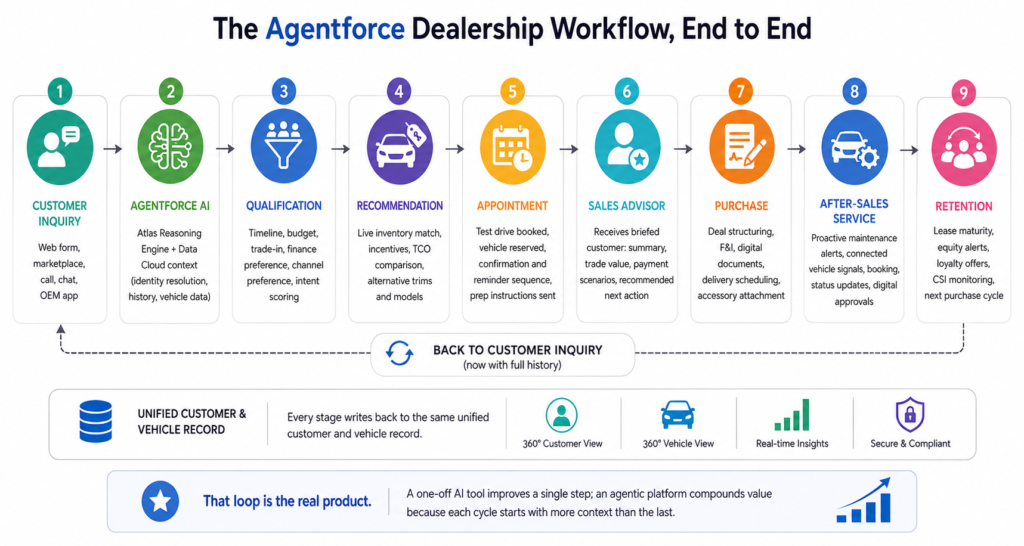
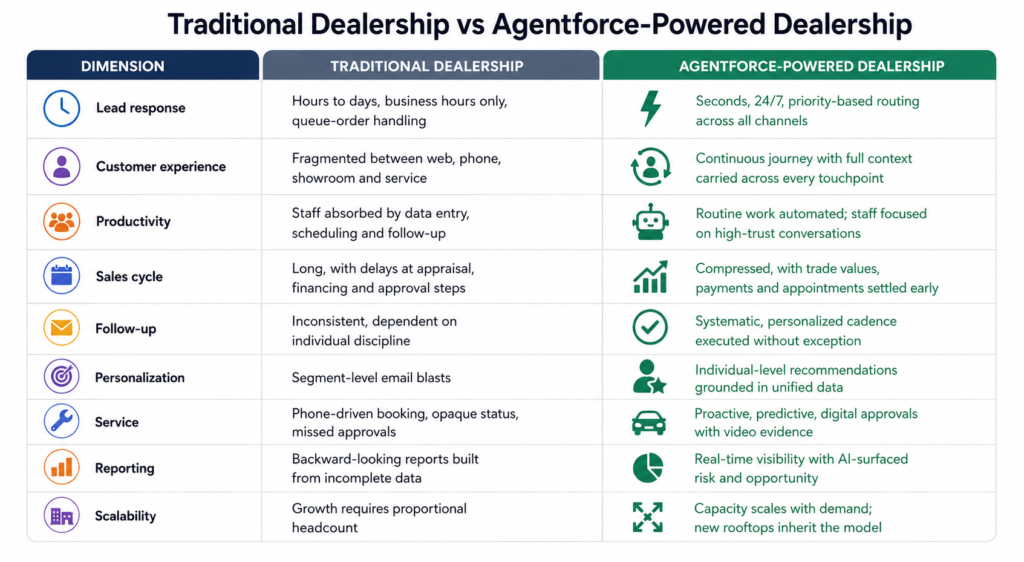
A short evidence base, drawn from primary industry research, for anyone building a business case.
Automotive AI adoption
Customer expectations
Digital retail
Lead response time
AI productivity and outcomes
CRM and platform adoption
That last statistic is the one to sit with. Data unification, not model quality, is the binding constraint on most AI programs.
1. Start with one workflow that has a measurable number attached. Lead response or service booking usually wins, because baseline metrics already exist and improvement shows within weeks.
2. Fix identity resolution before deploying anything. If one customer exists as four records across the CRM, DMS and marketing platform, the agent will behave inconsistently and staff will lose trust immediately.
3. Treat Data Cloud as the foundation, not an add-on. Agent quality is a direct function of the grounding data available. Budget accordingly.
4. Write explicit escalation rules. Define precisely when an agent hands off: pricing beyond a threshold, legal or complaint language, distressed customers, anything touching safety or recalls.
5. Design for the channels your customers actually use. In most markets that means text messaging first. Salesforce and Pied Piper data both show text overtaking email for dealership response.
6. Involve the sales floor and the service drive from week one. The people who will work alongside the agent should shape its tone, its scripts and its handoff format. Adoption is decided here, not in the steering committee.
7. Instrument everything. Track containment rate, escalation rate, appointment set rate, show rate, response latency and CSAT by workflow. Use observability tooling to review reasoning traces, not just outcomes.
8. Keep a human in the loop for financial and legal actions. Agents should prepare deals, quotes and appraisals. Humans should approve them.
9. Manage OEM and compliance requirements explicitly. Response time standards, data residency, consent rules and disclosure obligations vary by brand and jurisdiction. Encode them as guardrails rather than training slides.
10. Roll out by rooftop, then by region. Prove the model at one or two stores, capture what actually happened, and use that evidence to bring the rest of the group along.
11. Retire what the agent replaces. If a manual report, spreadsheet or callback list survives the deployment, you have added cost instead of removing it.
12. Review and retune monthly. Inventory, incentives and consumer behavior change constantly. Agent knowledge and guardrails need the same maintenance cadence as a website or price book.
The challenge: Duplicate customer records, missing VINs, inconsistent service history and disconnected marketing data. Only about a quarter of organizations report fully unified customer data.
How to overcome it: Run a data audit before implementation, not during it. Use Data Cloud identity resolution to build a single customer and vehicle profile, establish deduplication rules at the point of entry, and appoint a named owner for data quality inside the group.
The challenge: Sales and service staff often assume AI is a prelude to job cuts, and quietly work around it.
How to overcome it: Frame the agent as removing the worst parts of the job, then prove it with numbers from the pilot. Involve top performers in design. Report time saved, not just tasks automated. Adjust pay plans if the agent changes how appointments are sourced.
The challenge: The DMS, inventory feeds, OEM systems, telematics platforms and finance portals rarely offer clean modern APIs.
How to overcome it: Use MuleSoft to build a reusable integration layer instead of point-to-point connections. Sequence integrations by use case value rather than attempting a full-stack connection at once. Accept that some systems will be read-only for a period.
The challenge: Agents deployed but bypassed, or used only by a handful of staff.
How to overcome it: Embed the copilot where people already work, including Slack and the CRM console. Keep the interface conversational. Measure adoption per user weekly during the first quarter and coach against it.
The challenge: Autonomous systems taking actions nobody can explain or audit.
How to overcome it: Define agent scope narrowly, use guardrails and structured logic for anything deterministic, monitor reasoning traces through observability dashboards, and review escalation and error patterns on a fixed schedule.
The challenge: Advertising rules, finance disclosure obligations, recall notifications, consent requirements and OEM program terms all apply to what an agent says.
How to overcome it: Involve legal and compliance in agent design. Encode disclosures as required elements of responses. Maintain full conversation logs. Restrict pricing and finance statements to approved, current sources.
The challenge: Customer, vehicle and telematics data is sensitive, and consumers are increasingly aware of it.
How to overcome it: Apply data masking and toxicity screening through the platform’s trust layer, honor consent preferences per channel, minimize the data an agent can retrieve to what the task requires, and be transparent with customers that they are interacting with an AI assistant.
Autonomous dealerships. Not showrooms without people, but operations where the routine 70% of interactions run without human initiation, and staff are deployed almost entirely to high-value moments.
Predictive selling. Agents will increasingly identify who is likely to buy before the customer submits a lead, using equity position, service behavior, browsing signals and lifecycle events.
Generative AI across content and process. Vehicle descriptions, personalized video follow-ups, multilingual communication and deal documentation generated on demand and grounded in real inventory data.
Voice AI. Voice is becoming a first-class agent channel, handling inbound service calls, providing status updates and conducting outbound follow-ups with live transcription and instant human takeover.
AI copilots as standard equipment. Within a few years, expecting a salesperson to work without a copilot will feel like expecting them to work without a CRM.
Hyper-personalization. Every recommendation, offer and reminder tuned to the individual vehicle, driver and household rather than to a segment.
Connected vehicles as a demand engine. Telematics turns the parked car into a source of service revenue signals, from battery health to predictive component wear. This is the most underexploited asset in the industry.
Agentic AI across the ecosystem. Dealer agents, OEM agents, finance agents and supplier agents increasingly interoperating through open protocols, coordinating trade-ins, transfers, approvals and parts without human relay.
Data Cloud evolution. Unified data layers are absorbing unstructured content: repair notes, call transcripts, technical bulletins and video. As they do, the practical ceiling on agent capability rises with them.
Automotive retail has absorbed a great deal of technology over the past decade without fundamentally changing how the work gets done. Leads still sit. Follow-ups still slip. Service still runs on phone calls. Adding another point solution to that stack produces another login, not another sale.
What makes agentic AI different is that it acts. An agent that answers a midnight inquiry, values a trade, books a demo drive, alerts an owner to a failing battery and starts the upgrade conversation four months before lease maturity is not assisting the process. It is running the parts of the process that humans were never able to run consistently at scale, and handing people the conversations where they actually add value.
The dealerships that pull ahead over the next three years will not be the ones with the most AI tools. They will be the ones that redesigned a workflow, unified their data, trained their teams, and let the agent own the routine work end to end. The Agentforce automotive use cases described in this guide are the practical starting points, and each one can be piloted in weeks rather than quarters.
Cloudespacio works with dealer groups and OEMs to map high-value workflows, prepare the data foundation, and deploy Agentforce inside Salesforce Automotive Cloud. If you are evaluating where agentic AI fits in your operation, our team can run a workflow assessment and build a phased roadmap based on your current systems. Talk to our Salesforce automotive team.
Agentforce is Salesforce’s agentic AI platform for building, deploying and governing autonomous AI agents. Agents reason over unified customer data through the Atlas Reasoning Engine, take real actions inside business systems, and escalate to humans when needed. It is used across sales, service, marketing and industry-specific workflows including automotive retail.
The highest-value Agentforce automotive use cases are AI lead qualification and instant response, intelligent test drive scheduling, personalized vehicle recommendations, service appointment booking with predictive maintenance, trade-in evaluation assistance, customer retention and proactive engagement, and internal copilots for sales and service employees.
Yes. Agentforce is a Salesforce product and runs natively on the Salesforce platform. It works with Sales Cloud, Service Cloud, Marketing Cloud, Data Cloud, Experience Cloud and industry clouds including Automotive Cloud, sharing the same security model, data layer and governance controls as the rest of the Salesforce ecosystem.
A chatbot matches keywords to scripted replies and captures a form. An Agentforce agent reasons over live CRM, DMS and inventory data, plans multi-step actions, books appointments, updates records and triggers workflows. When it escalates, it passes a summary, the customer’s intent and a recommended next step rather than a raw transcript.
Yes, and it typically should. Agentforce handles everything a chatbot does while adding data grounding, real action execution, multi-channel continuity and governance. Most dealer groups retire their existing chat widget during implementation, since running both creates inconsistent answers and a fragmented customer experience.
Agentforce engages a lead within seconds of submission, at any hour, in the customer’s chosen channel. It qualifies intent, checks inventory, values a trade, and books an appointment autonomously. Given that five-minute response is roughly 21 times more effective than 30-minute response, this alone often justifies the investment.
Generally yes, through MuleSoft integration. MuleSoft connects Salesforce to dealer management systems, inventory feeds, OEM platforms, telematics providers and finance portals. Some legacy systems support read-only access initially. A discovery phase should map integration feasibility before implementation begins.
Automotive Cloud is Salesforce’s industry solution for automotive, providing a data model built around vehicles, VINs, drivers, households, dealers and OEMs, plus service history, warranties, leases and financing. It gives Agentforce agents the industry-specific context that a generic CRM cannot supply.
A focused first use case, such as lead response or service booking, typically reaches production in eight to sixteen weeks depending on data readiness and integration complexity. Group-wide rollouts across multiple workflows usually run six to twelve months, phased by rooftop and by use case.
Reported outcomes include a 30% lift in internet lead close rates and a 30% to 40% shorter sales cycle in early Agentforce Automotive CRM testing, alongside broader Salesforce findings of roughly 20% reductions in service costs and case resolution times. Actual results depend on baseline performance and data quality.
No. The practical model is division of labor. Agents handle qualification, scheduling, reminders, status updates and data entry. People handle demonstrations, negotiation, difficult service conversations and relationship building. Salesforce research shows AI frees roughly four hours per representative each week for higher-value work.
Agents can factor charging access, commute distance and total cost of ownership into recommendations, deliver EV orientation content before delivery, and monitor battery health signals from connected vehicles. This matters increasingly, since electric vehicles now represent about one in four new cars sold globally.
It needs unified customer profiles, accurate vehicle and VIN records, service history, live inventory, current incentives and finance programs, plus consent preferences. Data Cloud performs the identity resolution and harmonization. Poor data quality is the most common cause of disappointing agent performance.
Agentforce runs on Salesforce’s trust architecture with data masking, toxicity detection, audit logging and configurable guardrails. Dealerships should additionally encode brand-specific compliance requirements, advertising and finance disclosure rules, consent handling and data residency obligations into agent design.
Telematics data, mileage, service intervals and open campaigns flow into Data Cloud through MuleSoft. When a diagnostic signal or interval threshold triggers, the agent contacts the owner with a specific recommendation, available appointment slots, parts availability and loaner options, converting a passive signal into booked revenue.
Yes. Agentforce Voice provides a natural voice channel with live transcription, allowing agents to answer inbound service and sales calls, deliver status updates and conduct outbound follow-ups. Human staff can monitor conversations and take over instantly when the interaction requires judgment.
A traditional CRM records what happened and reminds people to act. Agentforce acts. It initiates contact, completes multi-step workflows, updates records automatically and escalates with context. The CRM becomes a system of action rather than a system of record that staff must remember to feed.
Most groups begin with Automotive Cloud, Sales Cloud or Service Cloud depending on the priority workflow, Data Cloud for unification, Agentforce for the agents themselves, and MuleSoft for DMS integration. Marketing Cloud, Experience Cloud and Revenue Cloud are typically added in later phases.
Track containment rate, escalation rate, first response latency, appointment set and show rates, service bay utilization, approval rates on recommended work, and CSAT by workflow. Salesforce research notes that 70% of organizations adopting AI agents see measurable value within 60 days.
Start with the workflow where a baseline metric already exists and improvement is visible fast, usually lead response or service booking. Audit data quality first, define escalation rules, pilot at one or two rooftops, measure honestly, and use those results to build the case for wider rollout.

Cloudespacio is a trusted Salesforce implementation partner headquartered in India, helping businesses transform sales, service, manufacturing, automotive, and customer operations with Salesforce.
Copyright © 2026 Cloudespacio Software Pvt. Ltd. All Rights Reserved.
