
One of the Market’s Leading Electric Vehicle Brands
Food & Beverage (Wine Distribution)
Automotive (Electric Vehicles)
Manufacturing & Mobility
Salesforce Automotive Cloud, Data Cloud, Agentforce for Automotive, Einstein Studio, OmniStudio, Vehicle Console, Action Relationship Graph, Rebate Management, Loyalty Management
Implementation
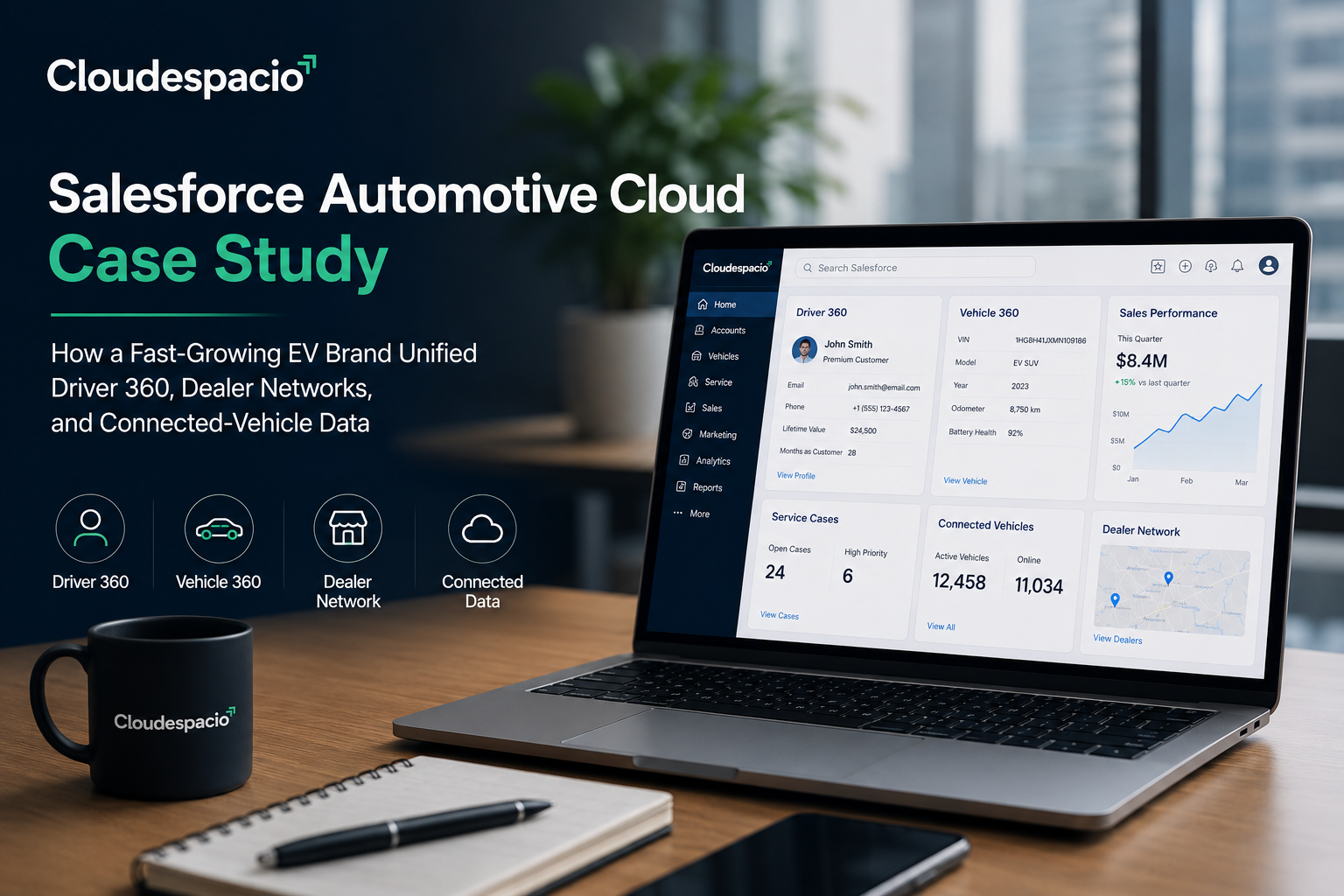
A fast-growing electric vehicle brand was scaling quickly, with new models, new markets, and more drivers, but its systems couldn’t keep up. This Salesforce Automotive Cloud case study shows how the brand replaced a patchwork of disconnected tools with one connected platform built for the automotive industry.
Customer data was scattered across the online configurator, dealer systems, the finance arm, and a separate connected-vehicle portal. Nobody could see the full picture of a single driver or a single vehicle. Leads slipped through the cracks. Service teams answered calls without knowing the vehicle in front of them. Rebates and loyalty rewards were tracked in spreadsheets. And a goldmine of connected-vehicle telematics data sat unused.
They needed an automotive CRM built for the way modern EV ownership actually works. That’s where Cloudespacio Software stepped in, designing and delivering a Salesforce Automotive Cloud implementation that unified the OEM, its dealer network, its captive finance arm, and its connected fleet.
Salesforce Automotive Cloud is an industry-specific automotive CRM built for automakers, dealers, and captive-finance companies. It extends the Salesforce platform with a purpose-built automotive data model and prebuilt experiences organized around Driver 360, Vehicle 360, and Customer 360. Compared with Salesforce Sales Cloud, Automotive Cloud vs Sales Cloud comes down to this: Sales Cloud is a general CRM, while Automotive Cloud ships with vehicle-native and driver-native objects, the Vehicle Console, Rebate Management, and Loyalty Management out of the box. This is what makes it the platform of choice for an auto dealership CRM and for OEM-scale operations alike.
The challenge of the project lies in addressing complex requirements, managing constraints, and delivering innovative solutions that meet objectives while staying on time and within budget.
The challenge of the project lies in addressing complex requirements, managing constraints, and delivering innovative solutions that meet objectives while staying on time and within budget.
The Salesforce Automotive Cloud implementation followed a data-first sequence. Data Cloud ingested and unified signals from the configurator, DMS, captive finance, and connected-vehicle telematics. The Salesforce Automotive Cloud data model structured that unified data into Driver 360, Vehicle 360, and Customer 360. OmniStudio and the Action Relationship Graph orchestrated the workflows on top, the Vehicle Console delivered a live Vehicle 360, and Agentforce for Automotive plus Einstein Studio added the AI layer. In short, Automotive Cloud unified the data, modeled the automotive relationships, orchestrated the workflows, and layered AI on top.
These are the core Salesforce Automotive Cloud implementation steps the brand followed, useful as a short implementation guide for any EV OEM or dealer:
The challenge of the project lies in addressing complex requirements, managing constraints, and delivering innovative solutions that meet objectives while staying on time and within budget.
The challenge of the project lies in addressing complex requirements, managing constraints, and delivering innovative solutions that meet objectives while staying on time and within budget.
A quick map of the Salesforce Automotive Cloud features and use cases put into production, and the examples that show who uses Salesforce Automotive Cloud and why:
The challenge of the project lies in addressing complex requirements, managing constraints, and delivering innovative solutions that meet objectives while staying on time and within budget.
The benefits of Salesforce Automotive Cloud for OEMs include a single source of truth across e-commerce, dealers, finance, and telematics, a direct relationship with drivers, commercialized connected-vehicle data, and AI leverage through Agentforce and Einstein Studio. The benefits of Salesforce Automotive Cloud for dealers include faster lead response, a complete customer view at the counter, streamlined delivery, automated incentives, and stronger loyalty and repeat business.
On Salesforce Automotive Cloud pricing: it is sold as a per-user, per-month subscription that varies by edition and add-ons such as Data Cloud, Agentforce, and Einstein. For an accurate quote, request current pricing from Salesforce or a certified partner such as Cloudespacio.
This EV brand didn’t just deploy new software. It changed how it connects with drivers across the entire life of every vehicle. With Salesforce Automotive Cloud and the support of Cloudespacio Software, the OEM, its dealer network, its finance arm, and its connected fleet finally operate on one connected, data-rich platform.
What used to take days now takes minutes. Telematics data that once sat idle now drives proactive service and smarter decisions. And drivers get an experience built around them, not around a one-time transaction, that lasts the full life of the vehicle.

Cloudespacio is a trusted Salesforce implementation partner headquartered in India, helping businesses transform sales, service, manufacturing, automotive, and customer operations with Salesforce.
Copyright © 2026 Cloudespacio Software Pvt. Ltd. All Rights Reserved.
